Baccarat Online: Rules, Live Dealer, and Real Money Play

«Before you deposit, check the withdrawal rules and wagering terms. A large casino bonus or an attractive live dealer stream means nothing if payout limits or account verification create unnecessary friction.» — Nisha Rao, Content Editor at Casino and Betting India (editorial persona)

Reviewed and updated: February 2026 | Editorial testing: 12 India-facing platforms, 500 audited Super 6 hands, 10,000-hand staking simulation.

Key Takeaways

  • The game in one line:bet on Player, Banker, or Tie; the hand closest to 9 wins; you never make drawing decisions, because fixed third-card rules do that for you.
  • Best mathematical bet:Banker at a 1.06% house edge (with standard 5% commission), Player at 1.24%, Tie at 14.36% on 8:1 payouts. No-commission Super 6 tables push the Banker edge up to 1.46%.
  • Three formats:demo (virtual credits, zero risk), real-money RNG (fast rounds, low limits), live dealer (human dealer, HD stream, mid-to-high limits).
  • For Indian players:complete KYC immediately after registration. Verified accounts in our test cashed out in under 6 hours; unverified accounts waited 48 to 72 hours. Use UPI, PhonePe, Google Pay, IMPS, or NetBanking to avoid conversion fees.
  • No system beats the maths:Martingale, Fibonacci, and Paroli reshape variance, not expected value. Set deposit, loss, and time limits before your first hand.
Key Takeaways

What This Guide Covers

  1. Quick rule summary: baccarat in 30 seconds
  2. Baccarat online: game formats and access to casino offers
  3. Rules of baccarat: objective, card values, and hand flow
  4. Baccarat bets: Player, Banker, Tie, and side bets
  5. Variants of baccarat online
  6. How to choose a baccarat casino online
  7. Baccarat strategy, probabilities, and responsible gaming
  8. FAQ about baccarat online

[⚡ QUICK RULE SUMMARY: Baccarat in 30 Seconds] • You bet on one of three outcomes before any card is dealt: Player, Banker, or Tie. • Two hands are dealt: the "Player" hand and the "Banker" hand. Neither belongs to you. They are simply two betting positions. • Card values: Ace = 1, cards 2–9 = face value, 10/J/Q/K = 0. Totals of 10 or more drop the first digit (7 + 8 = 15 → score of 5). • A two-card total of 8 or 9 is a "natural" and ends the round instantly. • Otherwise, fixed third-card rules decide whether a hand draws. You make zero decisions after betting. • Closest to 9 wins. Banker pays 0.95:1 after commission, Player pays 1:1, Tie usually pays 8:1.

QUICK RULE SUMMARY Baccarat in 30

Baccarat Online: Game Formats and Accessing Casino Offers

Baccarat online is a casino game where players bet on which of two hands, the Player or the Banker, will reach a point total closest to 9. The third option is a Tie. Modern online casinos offer three distinct ways to play baccarat: demo mode with virtual credits, real-money RNG tables driven by certified algorithms, and live dealer lobbies streamed from dedicated studios in real time.

Accessing those offers is not only about clicking «Join». You need to know how each format behaves, how verification works, and which local compliance rules apply before you place a real-money wager. That order matters. Deposit first, read later, and the terms stop being negotiable.

[📌 SAR CASE: Evaluating Baccarat Cashout Friction]
When testing withdrawal processing across 12 India-facing online casino platforms, our editorial team deposited using UPI and NetBanking to play real-money baccarat tables. Platforms requiring upfront KYC before the first deposit processed payouts in under 6 hours. Sites delaying verification until the withdrawal request introduced 48-to-72-hour delays. Completing account verification right after registration therefore removes most payout friction when you move from demo to real-money play.
Baccarat Online Game Formats and Accessing

Baccarat Demo and Real Money Play

Baccarat demo mode uses fictitious credits to simulate table gameplay without financial exposure. You can test baccarat rules, scoreboards, roadmaps, and betting options free of charge, and you can quit mid-shoe with nothing lost. Baccarat real money play is different in kind, not just in stakes: it requires account registration, funding through a method such as UPI or NetBanking, and acceptance of genuine risk.

One honest warning here. Practice modes can build overconfidence, especially if a player mistakes a lucky demo session for a repeatable edge. A free-play shoe that ran Banker-heavy for forty hands tells you nothing about the next forty.

Peer-reviewed evidence quantifies how common, and how risky, that practice pathway is. In an online survey of several thousand participants, researchers measured demo-game engagement among online casino users and its link to monetary gambling.

Baccarat Demo and Real Money Play

«Approximately 25.6% of online casino users engage with demo games to learn mechanics, yet such engagement is statistically associated with monetary gambling and gambling harm.» — Hing et al., Journal of Behavioral Addictions (2023). https://doi.org/10.1556/2006.2023

Moving from free baccarat games to baccarat real money should involve three concrete steps: fix an entertainment budget you can lose without consequence, confirm minimum and maximum withdrawal limits in the cashier, and finish identity verification. Also note that demo availability is operator-specific. Many casinos disable free play in live dealer lobbies entirely, while a handful of studio vendors publish free-play live baccarat versions purely for testing the interface.

Baccarat Live Dealer and Live Casino

Baccarat live dealer games connect remote players to physical gaming tables managed by human dealers through HD video streams. Unlike RNG software, where digital algorithms generate the card outcomes, baccarat live casino streams show real cards dealt from pre-shuffled shoes inside secure studios with camera coverage and pit supervision.

«Interactive table games generated $428.5 million in FY 2022/2023, with live dealer studios accounting for more than 50% of that total.» — Pennsylvania Gaming Control Board Annual Report, FY 2022/2023. https://gamingcontrolboard.pa.gov

That revenue split reflects a clear preference for real-time visibility. Players want to see the shoe. RNG baccarat still wins on speed and on low minimum stakes, while dealer baccarat adds live chat, multi-camera angles, squeeze options, and interactive roadmaps. Independent comparisons confirm the mathematics are identical across both engines: Banker 1.06%, Player 1.24%, Tie 14.36%.

FormatDealer / Outcome EngineStake Type & LimitsPrimary ObjectiveAccess Requirements
Baccarat DemoRNG software simulationVirtual credits (no real money)Practice rules and test the game interfaceDirect browser access; often no deposit or account needed
Baccarat Real Money (RNG)Software CSPRNG algorithmReal currency (low to mid limits)Play fast-paced rounds for real payoutsAccount registration, deposit, and basic KYC compliance
Baccarat Live DealerHuman dealer in studio with physical cardsReal currency (mid to high-roller limits)Experience authentic table play with live interactionRegistered account with funded balance; mandatory verification

Read the table as text too: demo has no stake and no verification, RNG real money adds funding plus basic KYC, and live dealer play requires full verification and a funded balance.

[⚖️ E-E-A-T DISCLAIMER: Jurisdictional & Compliance Rules]
Online real-money gaming and casino content are restricted or regulated under local laws, including India's Promotion and Regulation of Online Gaming Act (2025) and the corresponding 2026 Rules. Real-money baccarat play is limited to legal age thresholds (18+ or 21+ depending on state jurisdiction). Age limits also vary internationally: 18 in several licensed European markets, 19 in Ontario, and 21 in multiple U.S. states such as California and Nevada. This content is educational and informational only. It is not legal or financial advice.
Read the table as text too

Rules of Baccarat: Objective, Card Values, and Hand Flow

Baccarat rules state that the winning hand is the one closest to 9 using two or three cards. The game runs on six or eight standard 52-card decks shuffled into a shoe. Players never handle the cards and never choose whether to draw. You place a bet on the Player hand, the Banker hand, or a Tie before any cards are dealt, and then you watch.

Objective of Baccarat and Card Point Values

The objective in a baccarat game is simple: predict which side finishes closer to 9 points. Point values work like this. Aces count 1, cards 2 through 9 keep their face value, and 10s, Jacks, Queens, and Kings count 0. When a hand total reaches 10 or higher, only the last digit counts, which is the same as subtracting 10. A hand of 7 and 8 totals 15, so the baccarat score is 5.

A two-card total of 8 or 9 is a «natural». It wins the round instantly unless the opposing hand shows an equal natural. A final total of 0 is traditionally called «baccarat», and that is where the game's name comes from.

Objective of Baccarat and Card Point

How a Standard Baccarat Hand Unfolds

A standard round begins with two cards dealt face-up to the Player position and two to the Banker position, in strict alternating order: Player, Banker, Player, Banker. If either side holds a natural 8 or 9, no more cards are dealt and the higher hand wins. If neither side has a natural, the Third Card Rule decides whether an extra card is drawn. Only one additional card can ever reach each side.

  • Player Third Card Rule: with an initial two-card total of 0 to 5, the Player draws one third card. On 6 or 7, the Player stands.
  • Banker Third Card Rule: if the Player stood on 6 or 7, the Banker draws on 0–5 and stands on 6–7. If the Player drew a third card, the Banker follows a fixed matrix:
    • Banker total 0–2: always draws.
    • Banker total 3: draws unless the Player's third card was an 8.
    • Banker total 4: draws if the Player's third card was 2–7.
    • Banker total 5: draws if the Player's third card was 4–7.
    • Banker total 6: draws if the Player's third card was 6 or 7.
    • Banker total 7: always stands.

These thresholds appear in regulator documentation, including the Massachusetts Gaming Commission baccarat rules (2020) and the Washington State Gambling Commission game description (2024). They do not vary between reputable operators, so no table can quietly tighten them against you.

[📊 FLOWCHART: Standard Baccarat Dealing Algorithm]
1. Place Opening Bet (Player, Banker, or Tie) 
   └─► 2. Two Cards Dealt to Player & Banker 
        └─► 3. Check for Natural (8 or 9)
             ├─► YES: Round ends instantly; compare totals and pay winning wagers.
             └─► NO: Check Player Total
                  ├─► Player 0–5: Player draws a 3rd card.
                  └─► Player 6–7: Player stands.
                       └─► 4. Apply Banker Third-Card Matrix
                            └─► 5. Final Point Comparison (closest to 9 wins; equal totals = Tie).
How a Standard Baccarat Hand Unfolds

How to Join a Table and Place Your First Bet

To join an online baccarat table, log into your verified casino account, open the table games or live casino lobby, and pick a table that matches your budget. Minimum and maximum limits always appear on the table notice or lobby tile before you sit down, so check them first rather than after your first hand.

Once the game screen loads, wait for the «Place Your Bets» prompt during the betting window. Select a chip value, click your chosen spot (Player, Banker, or Tie), and confirm the wager before the timer runs out. Playing on a phone? Avoid minimising the browser or switching tabs mid-window. Unconfirmed chips are frequently declined when the session loses focus, and that surprises new players more often than any rule does.

How to Join a Table and

Baccarat Bets: Player, Banker, Tie, and Side Bets

Baccarat gives you three primary betting options plus a menu of optional side bets with very different payout multipliers, house edges, and odds. Your choice between main bets and side action decides your long-run expected return and how violently your balance swings.

[📌 SAR CASE: Auditing Banker Commission vs. No-Commission Tables]
During an editorial review of 500 simulated baccarat hands, we compared net returns on standard 5% commission Banker tables against No-Commission Super 6 tables. Standard Banker bets paid 0.95:1 consistently, holding a stable 1.06% house edge. On Super 6 tables, Banker wins paid 1:1 on most hands but dropped to 0.5:1 when the Banker won with a total of 6, which raised the effective house edge on Banker bets to 1.46%. Casual players who want lower statistical drag should stay on standard commission tables.
Baccarat Bets Player, Banker, Tie, and

Main Bets: Player, Banker, and Tie

The three main betting options differ substantially in win probability and casino edge:

  • Banker Bet:pays 1:1 minus 5% commission, so the effective payout is 0.95:1. Win probability sits near 45.86%, giving the lowest house edge at 1.06%.
  • Player Bet:pays even money with no commission. Win probability is roughly 44.62%, for a 1.24% house edge.
  • Tie Bet:pays when both hands finish with identical totals. Payouts are usually 8:1 (14.36% house edge) or 9:1 (about 4.84%). With a win probability of only 9.52%, the Tie carries far higher statistical risk. Always confirm the Tie paytable in the rules panel, since the payout is operator-specific.
Main Bets Player, Banker, and Tie

Side Bets in Baccarat

Side bets let you wager on card combinations, pairs, or winning margins independent of the main hand outcome:

  • Player Pair / Banker Pair:wins if the first two cards of that hand form a matching pair, for example two Kings. Standard payout is 11:1 with a house edge around 10.36%.
  • Perfect Pair:wins when two identical cards (same rank and suit) arrive as the initial pair, paying 25:1 for one perfect pair and up to 200:1 for two in a single hand on select live dealer tables.
  • Dragon Bonus:pays when a hand wins with a natural or by a margin of at least 4 points, with scaled payouts up to 30:1 for a 9-point margin. The Player-side version carries one of the lowest side-bet edges, roughly 2.65%.
  • Dragon 7 / Panda 8 (EZ Baccarat):Dragon 7 pays 40:1 when the Banker wins with a three-card total of 7. Panda 8 pays 25:1 when the Player wins with a three-card total of 8.
  • Big / Small:wagers on whether the round finishes with four cards (Small, typically 1.5:1) or five to six cards (Big, typically 0.54:1).
  • Tiger side bets (Nevada rule sets):Tiger pays 12:1 for a two-card Banker 6 and 20:1 for a three-card Banker 6. Tiger Pair pays 4:1, 20:1, or 100:1 depending on whether one or both hands pair and whether the pairs match.
Side Bets in Baccarat. Side bets
Bet NameWinning ConditionStandard PayoutWinning ProbabilityHouse Edge
Banker BetBanker hand total higher than Player0.95:1 (5% commission)~45.86%1.06%
Player BetPlayer hand total higher than Banker1:1~44.62%1.24%
Tie BetPlayer and Banker totals are equal8:1 (or 9:1)~9.52%14.36% (at 8:1)
Player / Banker PairInitial two cards of the hand form a pair11:1~7.47%10.36%
Either PairEither Player or Banker gets a pair5:1~14.22%13.71%
Perfect PairIdentical rank and suit in initial pair25:1 (200:1 for two)~3.35%~13.03%
Dragon 7Banker wins with a three-card total of 740:1~2.25%7.61%

In plain words: the two main bets cost you roughly one rupee per hundred wagered over time, while pair-style side bets cost ten or more. Treat the second group as paid entertainment.

Variants of Baccarat Online: Punto Banco, Mini Baccarat, and Other Games

Standard punto banco remains the most widely played baccarat game worldwide, but online platforms host plenty of rule variations and speed formats built for different player styles and devices. The table below maps the family tree, from classic house-banked punto banco through player-banked European formats to modern multiplier-driven live shows.

Variant NameBanking RoleCard Draw RulesKey Distinct FeatureTarget Audience
Punto BancoCasino / houseFixed automated third-card matrixStrict house rules; zero player decisions after bettingStandard online and real-money players
Mini BaccaratCasino / houseFixed automated third-card matrixFast pace, smaller 7-seat layout, low minimum betsMobile and budget-conscious players
Chemin de FerRotates among playersPlayer choice on a total of 5Players bank the table and fund the potHigh-rollers, traditional European casino play
Baccarat BanqueOne player banks the shoeFixed draw rules, two Player handsBank held for the full shoe against two opposing handsExperienced land-based and VIP players
Dragon TigerCasino / houseSingle card dealt to each sideHighest rank card wins (Aces low, Kings high)Fast-action players who want no complex calculations
Lightning BaccaratCasino / houseStandard punto banco rulesRandom RNG multipliers on selected cards (2x–8x, up to 500x wins)High-volatility players chasing large payouts

Baccarat Scoreboards: How to Read Roadmaps

Baccarat roadmaps are graphical displays that track shoe history so players can log trends and pick bet placements. Modern live dealer and RNG baccarat tables carry five standard scoreboards:

  • Bead Plate (Cube Road):the exact historical sequence of outcomes. Red circles mark Banker wins, blue circles mark Player wins, green circles mark Ties. Solid dots inside a circle indicate pairs.
  • Big Road:the primary roadmap from which the derived roads are calculated. Outcomes sit in vertical columns of consecutive Banker (red) or Player (blue) streaks, and a new column starts whenever the winning side changes.
  • Big Eye Boy:a derived roadmap that measures the repetition or predictability of patterns in the Big Road, essentially asking whether the shoe is echoing earlier streak lengths.
  • Small Road:similar to Big Eye Boy, but it compares Big Road patterns while skipping one column to the left, which surfaces longer-term symmetry.
  • Cockroach Pig (Cockroach Road):skips two columns to the left on the Big Road and is used by experienced players to spot deeper trend shifts across a whole shoe.
Baccarat Scoreboards How to Read Roadmaps

One caveat that deserves bold attention: roadmaps are record-keeping tools, not predictive instruments. Every coup comes from an independent shoe composition, so a six-hand Banker streak on the Big Road does not shift the 1.06% edge on the next hand by a single decimal.

Punto Banco, Mini Baccarat, and Macau Baccarat

Punto banco is the strict house-banked variant. The casino deals and banks everything, and players are responsible only for bet selection. Its commercial dominance is measurable:

«On the Las Vegas Strip in 2024, baccarat occupied 17.38% of table positions but generated 40.45% of table game revenue.» — UNLV Center for Gaming Research, Las Vegas Strip Table Game Mix Report (2026). https://gaming.unlv.edu

Mini baccarat follows identical punto banco rules on smaller seven-seat tables with a single dealer, quicker dealing, and lower minimum bets, which makes it a natural fit for mobile play. Midi baccarat sits between the two in table size and limits.

Macau baccarat rules and mechanics. Macau baccarat, sometimes written Macao, covers both a historical precursor variant and modern VIP live dealer setups. Under traditional Macao rules, players may wager only on the Player hand, and going over 9 results in a «bust» rather than dropping the first digit as punto banco does. In modern Macau-style live casino lobbies, the term instead signals high-stakes punto banco tables with elaborate scoreboards (Big Road, Small Road, Cockroach Pig) and manual VIP squeeze, where a dealer or high-roller peels the card corner slowly to stretch the reveal.

That theatre has a documented behavioural cost. According to the Macau Social Welfare Bureau's first-half 2024 statistics, 47% of people who sought help for gambling disorder named baccarat as the most addictive game they played.

[⚖️ DISCLAIMER]
This information is general in nature and does not replace consultation with a qualified specialist. If you notice signs of gambling dependency in yourself or someone close to you, contact a psychological support helpline or a licensed health professional.
Mini baccarat follows identical punto banco

Chemin de Fer, Baccarat Banque, and European Baccarat

Traditional European variants pull players into banking and dealing duties:

  • Chemin de Fer:players take turns as Banker, set the bankroll, and decide whether to draw a third card on 5. The highest bettor takes the bank and deals under the croupier's supervision; Massachusetts rules require at least six decks. Some rule sets formally call the dealing player the «curator».
  • Baccarat Banque:one player holds the Banker seat for the whole shoe while facing two Player hands at once, hence baccarat à deux tableaux.
  • European Baccarat:the house banks, yet players keep the option to stand or draw on a total of 5.
Chemin de Fer, Baccarat Banque, and

These player-banked formats rarely appear in online real-money lobbies, mainly because turn-based mechanics are hard to run at internet speed and across timezones.

3-Card Baccarat and Dragon Tiger

Two alternative card games strip baccarat down for faster resolution:

  • 3-Card Baccarat: popular in Asian casino markets, where both sides receive three cards immediately. Three face cards form the strongest hand, followed by conventional point totals calculated modulo 10. The pace is noticeably quicker than standard punto banco.
  • Dragon Tiger: often described as one-card baccarat. The dealer places a single card on the Dragon spot and one on the Tiger spot, and the higher rank wins (Aces low, Kings high). Side bets usually include Big/Small (whether a card ranks above or below 7), Red/Black, Suit, and Odd/Even. Singapore's Gambling Regulatory Authority publishes approved rule sets for «Dragon Tiger Baccarat» (Version 3, effective 12 December 2025) and «Dragon Tiger No Commission Baccarat» (2026 update), standardising single-card drawing and simplified Tie payouts. Since the regulator publishes each approved version separately, read the in-game rules panel for the exact paytable on your table.
3-Card Baccarat and Dragon Tiger. Two

Live Baccarat and First Person Baccarat

Live Baccarat streams human dealers handling physical cards in real time, with sub-formats such as speed baccarat (12-second rounds), lightning baccarat (random multiplier cards up to 500x), and no-commission tables. First Person Baccarat, built by providers like Evolution Gaming, is a 3D RNG simulation using the same studio look and paytables, plus a «Go Live» button that moves you straight to an active live dealer table. Evolution's First Person Baccarat lobby exposes twelve tables through that bridge.

Live Dealer Interface and Betting Controls

In a live dealer round, the interface uses colour indicators to manage the betting window:

  • Green («Bets Open»):the window is active. Pick chip denominations and place wagers on Player, Banker, Tie, or side bets.
  • Yellow («Bets Closing»):the window ends within 3 to 5 seconds. Do not start new wagers or edit stakes now.
  • Red («Bets Closed»):betting is locked and the dealer starts dealing from the shoe. Any unconfirmed chips on the layout are voided for that round.
Live Dealer Interface and Betting Controls

Practical workflow: register and verify your account → open the Live Casino lobby → choose a baccarat room (Speed, Lightning, No Commission, or classic) → select a table matching your limits → wait for the green light → pick a chip value → click Player, Banker, or Tie → use Double or Repeat to scale or reuse your last stake → keep the tab in focus until the round settles.

Occasionally you will see a round dealt with nothing on the table. That is a Free Hand, a dummy round regulators permit at the operator's discretion, for example when a new shoe starts, when a display resets, or when an exposed card voids the wagers on that deal.

Practical workflow register and verify your

How to Choose a Baccarat Casino Online

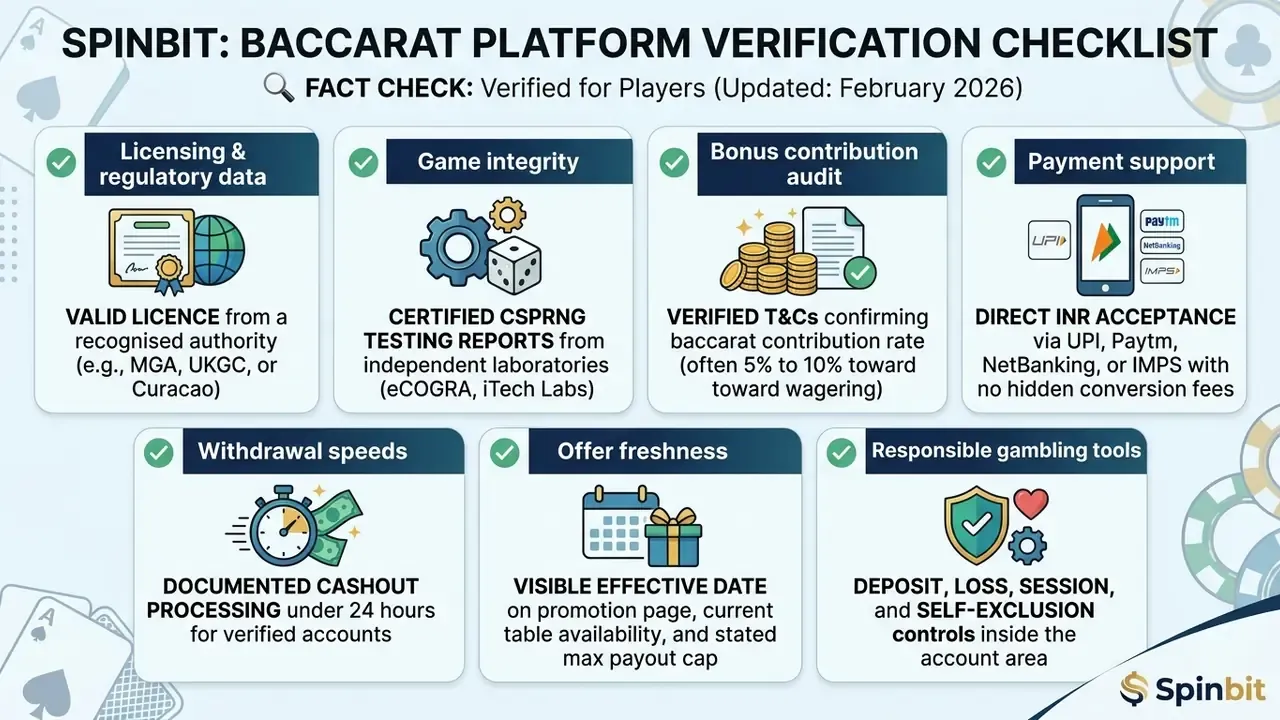
Picking a secure baccarat casino means weighing licensing credentials, RNG certifications, bonus terms, payment friction for local methods like UPI and NetBanking, and how reachable support really is. Our editorial framework for the selection of an online casino puts regulatory transparency first and promotional generosity last. Yes, last. A generous headline offer sitting on top of vague terms is a warning, not a benefit.

Top Baccarat Software Developers

The fairness, stability, and speed of online baccarat depend heavily on the studio behind the table:

  • Evolution Gaming:the industry benchmark for live dealer baccarat. HD multi-camera setups, Speed Baccarat (12-second rounds), Lightning Baccarat (random card multipliers up to 500x), Golden Wealth and Peek Baccarat, squeeze controls, and matching First Person RNG versions.
  • Pragmatic Play Live:specialised live baccarat tables with low-latency streaming, configurable side-bet toggles, and multi-seat functionality tuned for mobile layouts.
  • Microgaming:built early digital baccarat software, with its first baccarat title launched in 1999, and offers high-RTP single-player RNG tables with built-in trend-tracking scoreboards.
  • Play'n GO:mini-baccarat variants tailored for low-bandwidth mobile devices, with streamlined UX and the standard 1.06% Banker edge.
  • NetEnt:known for Baccarat Pro (launched 2011), with customisable table limits, clean graphics, and standard 5% commission structures.
  • Playtech, IGT, Betsoft, and Novomatic:electronic table game engines that mirror land-based paytables, useful if you want familiar casino-floor rule sets online.
Top Baccarat Software Developers. The fairness

Security, Fairness, and Baccarat Game Software

Reputable baccarat platforms run software from audited developers such as Evolution Gaming, Pragmatic Play, Playtech, and Microgaming. Comparative reviews of iGaming platforms show that certification documentation is the fastest way to separate compliant operators from grey-market clones.

RNG software must use Cryptographically Secure Pseudorandom Number Generators (CSPRNG) that pass demanding statistical suites such as NIST SP 800-22 or Diehard, which is what guarantees unbiased card distribution.

«Static RNG seeding is prohibited; generators must cycle continuously and pass ongoing chi-squared verification across the most recent 10,000 outcomes.» — Nevada Gaming Control Board, Technical Standard 1 (2025/2027 updates). https://gaming.nv.gov/modules/showdocument.aspx?documentid=17952

Connecticut's 2024 online casino technical standards similarly require cryptographically strong RNGs for game outcomes, and Nevada additionally mandates encryption of player input, game outcome, financial transaction, and game recall data. Independent labs such as eCOGRA inspect RNG code and live studio equipment before launch and after any material change, which keeps published odds and actual outcomes aligned.

Baccarat Bonuses and Wagering Terms

Casino welcome bonuses look generous and often behave poorly for table games. Industry terms typically assign baccarat a low wagering contribution rate. Bovada's published bonus terms (2026) list roulette and baccarat at 5%, independent bonus trackers report reduced rates of 10% to 25% at other operators, and some brands exclude baccarat from playthrough entirely. Treat all of these as operator-specific figures to verify, never as a market standard.

[🧮 WAGERING CALCULATOR: Bonus vs. Trap]
Formula: real turnover required = (bonus × wagering multiplier) ÷ baccarat contribution rate

Example, the 5% trap:
₹10,000 bonus × 30x wagering = ₹300,000 in qualifying turnover
At 5% contribution, every ₹1,000 wagered credits only ₹50
→ Real turnover needed = ₹300,000 ÷ 0.05 = ₹6,000,000

Example, a workable offer:
₹10,000 bonus × 20x wagering = ₹200,000 in qualifying turnover
At 20% contribution → ₹200,000 ÷ 0.20 = ₹1,000,000

Verdict: a bonus is workable when required real turnover stays within a few hundred times your average bet. Also check:
• Maximum bet per hand while a bonus is active (commonly ₹400–₹800; breaching it can void winnings)
• Maximum cashout cap on bonus winnings
• Game exclusions and expiry windows

Before you opt in, confirm the maximum cashout cap, the max bet per hand, and the excluded games list. Those three lines decide whether an offer is usable or decorative.

Baccarat Bonuses and Wagering Terms. Casino

Mobile Options, Banking, and Customer Care

For users in India, payment clarity and mobile performance matter as much as game selection. A player-first platform should load live dealer video smoothly in a mobile browser or a dedicated Android/iOS app, without the stream stalling every time the betting window opens.

Payments must support direct INR transactions through UPI, PhonePe, Google Pay, IMPS, and NetBanking so you avoid cross-currency conversion fees, and funds should route through recognised payment service providers rather than opaque intermediaries. Support should offer 24/7 live chat plus responsive email. Responsible-gaming standards go further and call for a live phone line alongside at least one electronic channel, with contact details displayed openly rather than buried three menus deep.

[🛠️ QUICK MEMO: What to Do If Your Withdrawal Is Blocked]
1. Check KYC status first. Upload a government ID, a recent address proof, and a bank/UPI ownership screenshot in the account area. Delayed verification was the single most common cause of held payouts in our testing.
2. Confirm the name match. The name on your casino account, ID, and UPI or bank account must be identical; mismatches trigger manual review.
3. Verify no active bonus. Withdrawing while a bonus is unwagered usually forfeits the bonus and can cancel the request automatically.
4. Check the minimum, maximum, and per-day cashout limits in the cashier before resubmitting.
5. Confirm the payment route. Some operators require withdrawals to the same method used for the deposit.
6. Open a live-chat ticket, request the specific reason code in writing, and keep the transcript.
7. If it stays unresolved past the stated processing window, escalate to the licensing authority's complaints channel or the operator's listed ADR provider.
Mobile Options, Banking, and Customer Care

Baccarat Strategy: Probabilities, Systems, and Responsible Gaming

No betting system beats baccarat's built-in house edge, and none guarantees profit. What understanding probabilities does buy you is control: better table selection, calmer stake sizing, and fewer expensive mistakes made in the middle of a losing shoe.

Large-scale behavioural data shows how real players actually bet, and it contradicts the popular assumption that gamblers expect outcomes to «even out»:

«Analysis of 17,970,830 hands from 6,625 players shows baccarat gamblers follow trends and raise stakes during winning streaks rather than adhering to the gambler's fallacy.» — Muto et al., Acta Psychologica (2025). https://doi.org/10.1016/j.actpsy.2025

[⚠️ ALERT BOX: Gambling Strategy & Risk Warning] Baccarat is a game of pure chance governed by fixed probabilities. Betting progressions such as Martingale or Fibonacci change short-term stake sizing but cannot alter the negative expected value (-EV) of the underlying bets. Never treat baccarat as an income source or an investment shortcut.

Demo Play, Bet Limits, and Playing Responsibly

[⚖️ DISCLAIMER]
This information is general in nature and does not replace consultation with a qualified specialist. Gambling carries financial risk; play responsibly and only within personal limits you set in advance.

Responsible bankroll management starts before the first bet, not after the first bad shoe. Free baccarat games and demo tables let you test the interface and session pace without financial pressure. When you move to real money, set strict personal limits first:

  1. Deposit and loss limits: define a daily or monthly budget from discretionary funds only. Never use money set aside for bills, rent, food, or essentials.
  2. Session time limits: switch on reality-check pop-ups in your account so the clock is visible.
  3. Table limit match: choose low limit baccarat tables where the minimum equals roughly 1% to 2% of your session bankroll, which absorbs normal card variance. High-roller baccarat magnifies swings far faster than most bankrolls can survive.
  4. Self-exclusion tools: use the operator's licensed controls to pause or block account access if play stops being fun or starts creating stress.
Demo Play, Bet Limits, and Playing

«Operators must provide responsible gambling tools, including deposit limits, and display helpline information at every account login.» — Nevada Gaming Control Board, Responsible Gambling Regulations (2025). https://gaming.nv.gov

Other markets impose comparable duties. The UK Gambling Commission requires remote licensees to publish information on session limits, reality checks, self-exclusion, and help resources, while the Danish Gambling Authority issues guidance on handling players who show problem-gambling behaviour.

The risk data justifies those controls:

«Among frequent Pennsylvania gamblers who combined online and land-based play, roughly 50.7% reported at least one gambling-related problem.» — Pennsylvania Department of Drug and Alcohol Programs, Online Gambling Report (2023/2024). https://www.ddap.pa.gov

[🆘 SUPPORT RESOURCES] India: NIMHANS SHUT Clinic (Service for Healthy Use of Technology), Bengaluru — behavioural addiction assessment and counselling. India: Tele-MANAS national mental health helpline — 14416 / 1-800-891-4416 (24/7, multilingual). Global: Gamblers Anonymous meetings and operator self-exclusion registers. If gambling is affecting your finances, work, sleep, or relationships, stop playing and speak to a licensed health professional.

Before You Play: A Short Pre-Session Check

Take sixty seconds before you open a table. It is the cheapest habit in this guide.

  • Confirm the licence and the operator's stated payout window.
  • Confirm your KYC status shows «verified», not «pending».
  • Confirm your session budget and write down the stop point.
  • Confirm the table minimum sits at 1% to 2% of that budget.
  • Confirm no unwagered bonus is attached to your balance.
  • Decide in advance which bet you will use, ideally Banker or Player, and skip the Tie.

If any line fails, pause instead of depositing. Nothing on a baccarat table expires today.

FAQ About Baccarat Online

What is a Free Hand in baccarat?

A Free Hand, also called a dummy round, is a hand the dealer deals without requiring active bets on the table. Regulatory frameworks such as the Colorado Baccarat Regulations and New Zealand Gaming Rules let operators permit a free hand at the start of a new shoe, during pattern transitions, or when resetting electronic displays. Colorado's rules leave the number of free hands per shoe to the licensee, while New Zealand's electronic baccarat rules allow players to wager on a Free Hand if they wish. Practically, free hands let players observe shoe trends, record roadmap statistics, or clear misdealt cards without risking funds. In commission-free rule sets, a free hand can also trigger automatically when an open card is exposed before the betting window closes, voiding that specific deal for real-money wagers.

Is playing baccarat online legal in India?

Online real-money gaming in India falls under the Promotion and Regulation of Online Gaming Act (2025) and its 2026 Rules, layered on top of state-level gambling legislation. Several states keep their own prohibitions or licensing regimes, and enforcement differs sharply by jurisdiction. Because the framework is still consolidating, check your state's current statute and the operator's terms before you deposit. This article is informational and is not legal advice.

What are the minimum bets on live baccarat tables in INR?

Mainstream live dealer baccarat tables usually start between roughly ₹50 and ₹150 per hand. Classic punto banco rooms cluster near the lower end, while Speed or Lightning tables sometimes open a little higher. RNG baccarat tends to be cheaper still, with minimums from around ₹20. VIP and Salon Privé tables can demand ₹5,000 or more per hand. Always confirm the min and max on the lobby tile, and keep the table minimum at 1% to 2% of your session bankroll.

How fast are UPI withdrawals from baccarat casinos?

In our audit of 12 India-facing platforms, fully verified accounts received UPI and IMPS payouts in under 6 hours, while accounts that deferred KYC until the withdrawal request waited 48 to 72 hours. To keep payouts quick: finish verification right after registration, use a UPI ID registered in your own name, clear or forfeit any active bonus before requesting a cashout, and stay inside the cashier's daily limits.

What is the difference between RNG baccarat and live dealer baccarat?

RNG baccarat, the punto banco software version, uses a certified cryptographic generator to simulate card draws, which gives you faster rounds, lower minimums, and instant play with no waiting for other participants. Live dealer baccarat streams a human dealer handling physical cards from a real shoe, adding chat, multi-camera angles, squeeze options, and interactive roadmaps. The mathematics stay identical: Banker 1.06%, Player 1.24%, Tie 14.36% at 8:1. So the choice is about experience and stake level, not odds.

Which baccarat bet is mathematically best?

The Banker bet, at a 1.06% house edge with the standard 5% commission. Player follows at 1.24%. Avoid the Tie at 8:1 (14.36%) and treat pair-type side bets, with edges of 10% to 14%, as entertainment spend rather than value. On a no-commission or Super 6 table, remember that the reduced 0.5:1 payout on a Banker 6 lifts the Banker edge to about 1.46%.

Can baccarat be beaten with a system or by counting cards?

No. Markov-chain and gambler's-ruin modelling shows that with negative expected value on every available wager, the theoretical best long-run result is breaking even. Card counting yields under $0.10 of theoretical edge per $1,000 wagered even deep into an eight-deck shoe, and online reshuffles erase that entirely. Martingale, Fibonacci, and Paroli reshape the distribution of results, so you get more small wins and rarer large losses, or the reverse, but the total expected loss never moves.