Last updated: 2026. Reviewed for factual accuracy against Evolution Gaming product documentation, Pennsylvania Code § 690.1 wheel specifications, and published Loto-Québec rule sheets.
Quick summary: eight things worth knowing before anything else

Last updated: 2026. Reviewed for factual accuracy against Evolution Gaming product documentation, Pennsylvania Code § 690.1 wheel specifications, and published Loto-Québec rule sheets.
Quick summary: eight things worth knowing before anything else
Provider
RTP
Volatility
Min bet
Max bet
Max win
This guide moves from the basics to the parts that actually cost people money. First the format and the wheel, then the round flow and the Top Slot maths, then all four bonus games. After that come demo mode and its limits, operator checks for real-money play, the India-specific legal, tax and payment layer, RTP with strategy reality checks, mobile play and fake apps, a comparison with rival game shows, and a plain-English FAQ.
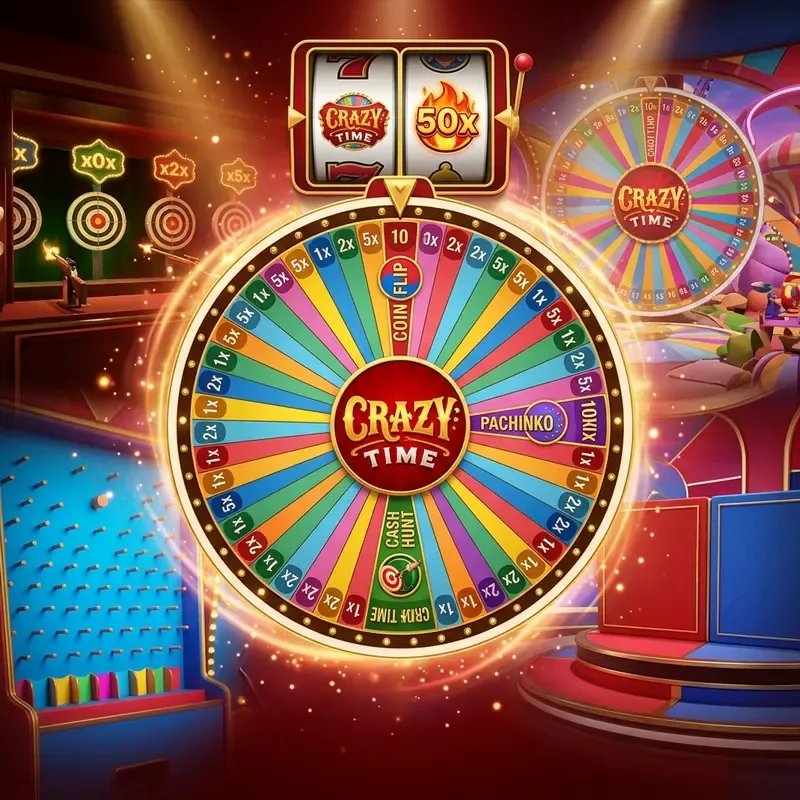
Crazy Time is a live game show developed by Evolution Gaming that combines a physical 54-segment money wheel, an automated pre-spin multiplier Top Slot, and four distinct bonus rounds in a continuous 24/7 live broadcast. Unlike traditional video slots, Crazy Time operates as a live casino game hosted by real presenters, with published theoretical Return to Player (RTP) rates ranging from 94.33% to 96.08% depending on the specific bet spot selected.
Crazy Time is an online live casino game show developed by Evolution Gaming that merges physical wheel spins with random number generator (RNG) multiplier features. At its core, Crazy Time is a live stream led by real presenters, and that single fact separates it from standard video slot machines built entirely on digital reel animations.
«Crazy Time integrates television game-show elements of the "Wheel of Fortune" type with real-time hosts, multiple bonus rounds, and carnival-style aesthetics.» — Academic analysis of innovative approaches to online live casino games (2024)
The title was first unveiled by Evolution Gaming's Chief Product Officer Todd Haushalter at ICE London in 2020, launched commercially on 1 July 2020, and went on to win the Innovation in Casino Entertainment award at the SBC Awards 2020. Evolution operates the product under master B2B regulatory approvals including MGA/B2B/187/2010 (Malta Gaming Authority critical supply licence) and UK Gambling Commission account #41655, held by Evolution Malta Holding Limited for remote gambling software and game host activity. The game was later rolled out into individually regulated US markets, New Jersey in 2023 and Michigan in 2024, each requiring separate state-level approval of the physical wheel and the RNG components.
Crazy Time by Evolution Gaming is broadcast live around the clock from dedicated European studios, using multi-camera video streaming to deliver continuous real-time gameplay. If you are still comparing formats, it helps to see how this title sits alongside other live casino games built on hosted broadcasts rather than RNG reels.
The studio features a custom 54-segment money wheel built by TCS John Huxley, an automated Top Slot screen above the wheel, and physical sets for the interactive bonus games. Under Pennsylvania Code § 690.1, the certified wheel must measure at least five feet in diameter with 54 equally spaced sections and a clapper (also called a flapper) that determines the winning section once the wheel comes to rest. Live presenters host every round: they spin the wheel, launch bonus features, and talk to players through an interactive chat panel. According to official product specifications from Evolution Gaming, the live stream layers augmented reality graphics over the physical outcome, so virtual multipliers and the real wheel read as one scene on desktop and mobile alike.
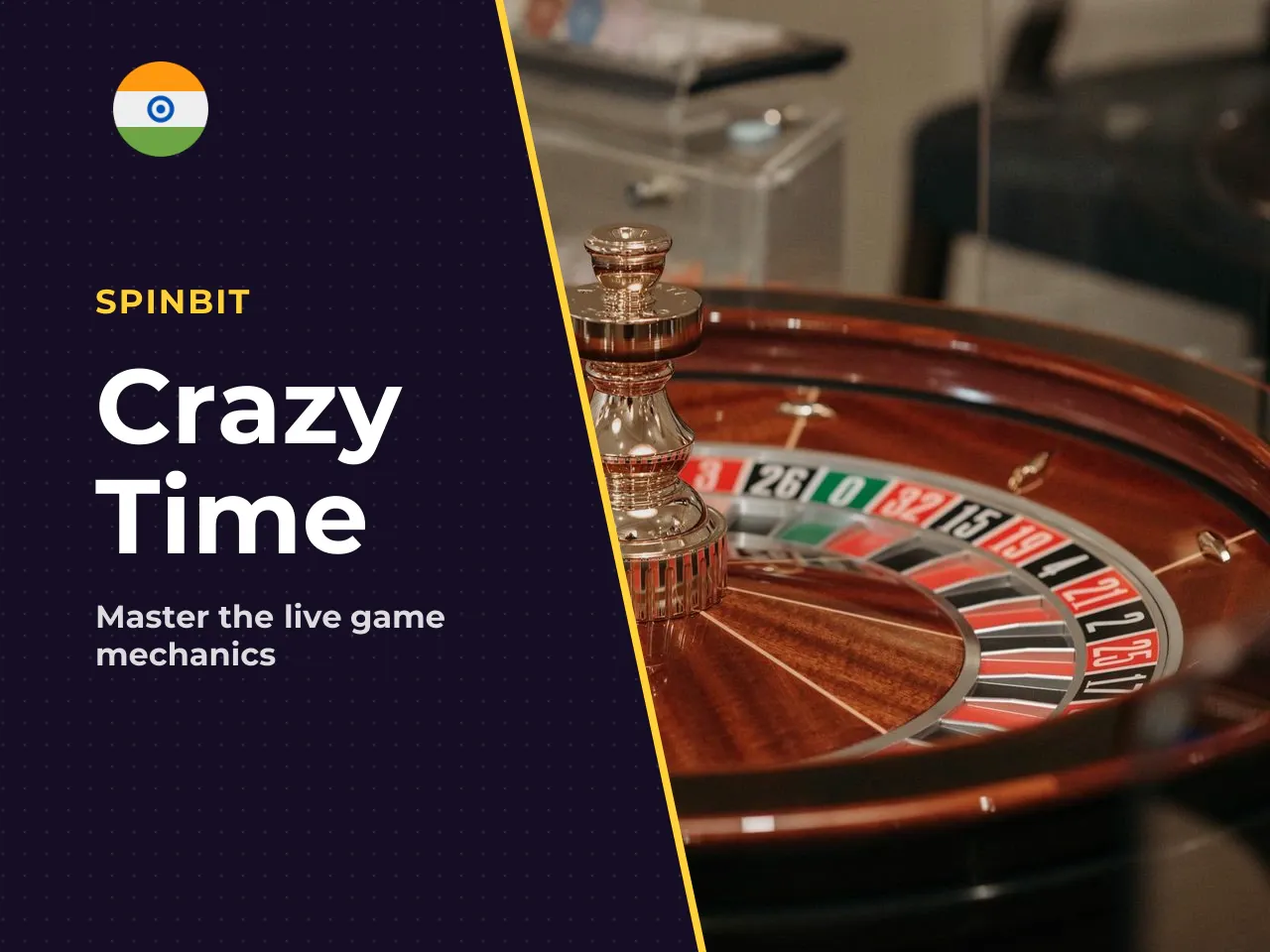
People often call it a crazy time slot, but structurally the game is a live money wheel show rather than a reel-and-payline video slot. Traditional slots resolve outcomes asynchronously through random number generators that align symbols across paylines for one individual player. The Colorado Division of Gaming's public explainer "Taking the Mystery Out of the Machine" (2015) describes exactly that: reel stops matching a payline, with the processor calculating the payout from odds and wager.
Crazy Time works the other way round. It resolves synchronously for thousands of concurrent players, so every participant watches the same physical wheel spin, the same Top Slot alignment, and the same game results at the same second. The phrase crazy time slots usually points at the hybrid design, where the Top Slot borrows two-reel slot mechanics to assign random multipliers to specific wheel outcomes before each spin. A slot-flavoured layer on a live wheel, in short.
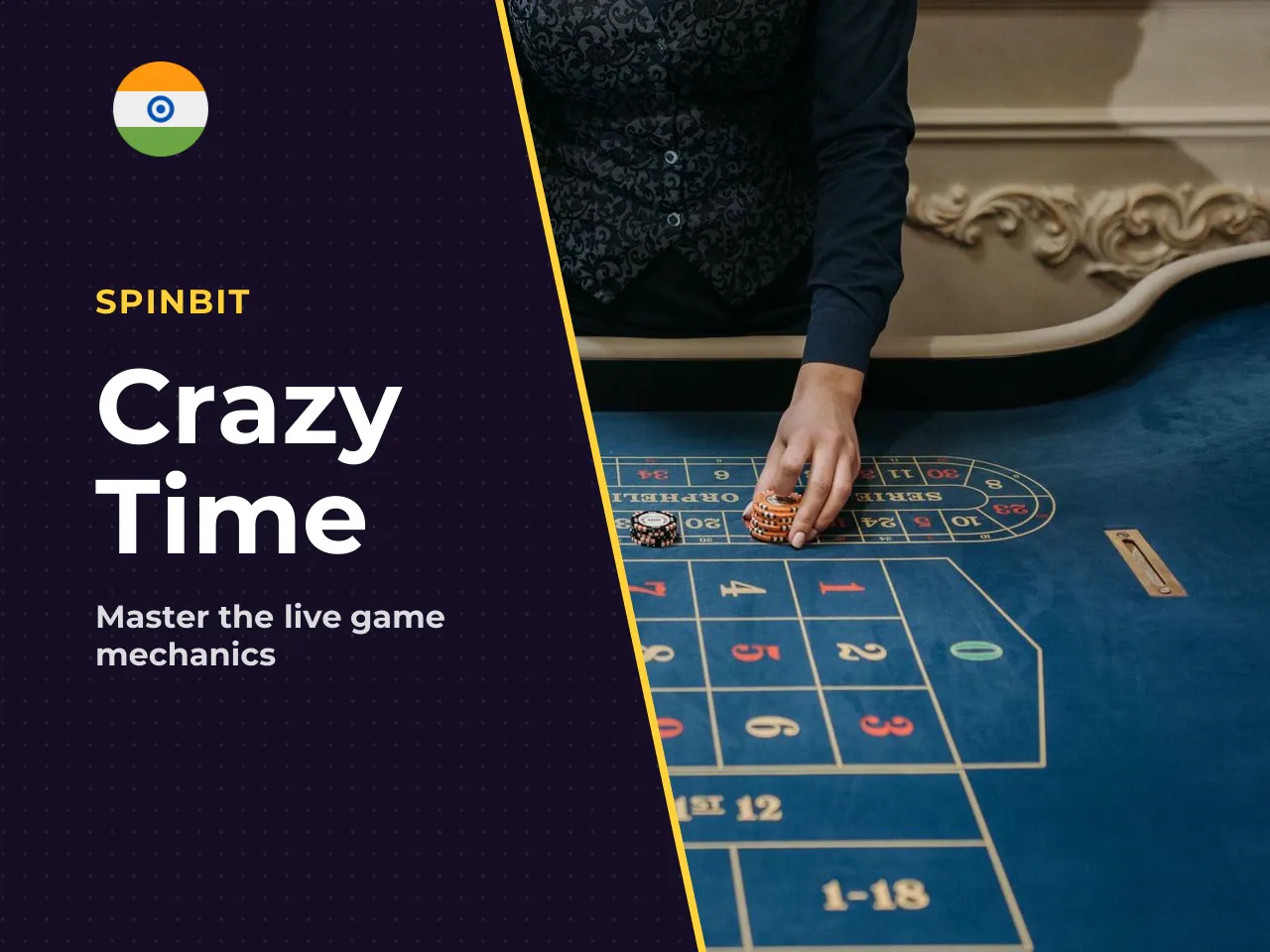
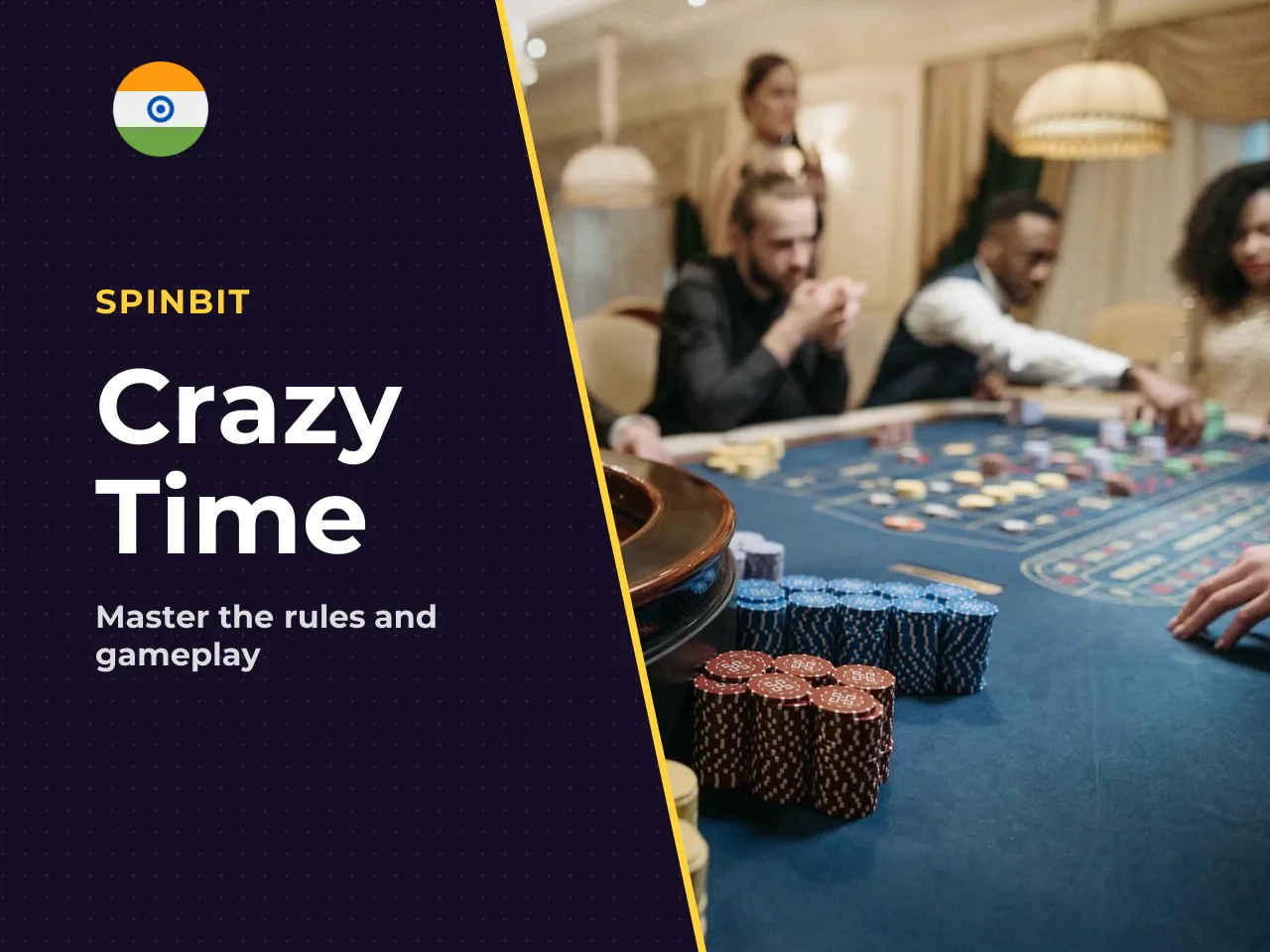
Crazy Time play starts with a decision window of roughly 12 to 15 seconds, during which you place wagers on any of the eight betting spots before the host spins the 54-segment wheel. A round then resolves in one of two ways: an instant payout on a number segment, or a transition into one of four interactive bonus rounds for qualifying players.
Round sequence in five steps:
The main wheel carries 54 equal physical segments: four number choices (1, 2, 5, and 10) plus four bonus round spots. Number segments account for 45 of the 54 pockets, and they pay at the face value of the number.
| Segment Label | Total Segments on Wheel | Theoretical Probability | Base Payout Ratio |
|---|---|---|---|
| 1 | 21 | 38.89% | 1:1 |
| 2 | 13 | 24.07% | 2:1 |
| 5 | 7 | 12.96% | 5:1 |
| 10 | 4 | 7.41% | 10:1 |
| Coin Flip | 4 | 7.41% | Variable (up to 5,000x) |
| Cash Hunt | 2 | 3.70% | Variable (up to 10,000x) |
| Pachinko | 2 | 3.70% | Variable (up to 10,000x) |
| Crazy Time | 1 | 1.85% | Variable (up to 20,000x) |
When the wheel stops on a number, players who backed it get their stake returned plus profit calculated as Payout = Stake × (Base Multiplier × Top Slot Multiplier).
«Observed hit frequencies across millions of tracked spins match theoretical probability: Coin Flip 7.21% (theory 7.41%), Cash Hunt 3.69% (theory 3.70%).» — Live-data aggregator tracking millions of Crazy Time spins (specialist tracking service)
That convergence is the strongest practical evidence that the physical wheel is mechanically fair. Over very large samples, reality drifts toward the segment maths, not away from it.
The Top Slot is a two-reel automated generator that spins alongside the physical money wheel in the opening seconds of every round. The left reel selects one of the eight betting spots. The right reel selects a random multiplier value, typically between 2x and 50x.
If the two reels align horizontally on a single bet spot, that multiplier is assigned to the matching wheel segment for the active round. Should the wheel then land on that same boosted segment, the Top Slot multiplier scales the base payout for numbers, or scales all internal multiplier values inside a bonus game.
«The maximum Top Slot multiplier is 50×; in Coin Flip, stacking a 50× Top Slot on a 100× base outcome produces 5,000× the stake.» — Evolution Gaming official product documentation and independent technical review. https://games.evolution.com/live-casino/game-shows/crazy-time/
Multiplier ranges are jurisdiction-dependent, and that catches people out. The Pennsylvania rule set for Crazy Time lists Top Slot multipliers of 1, 2, 3, 4, 5, 7, 10, 15 and 20, while Loto-Québec and current global rule summaries describe a ceiling of 50x. So read the in-client rules tab for the table you are actually seated at. One more detail that matters: if the two reels do not align on both a bet spot and a multiplier in the same round, no Top Slot multiplier applies at all.
📐 Worked Example of Top Slot Multiplier Stacking
- Player stake: $10 on segment "5" (base payout 5:1).
- Top Slot alignment: segment "5" plus a 4x multiplier.
- Wheel outcome: the flapper stops on segment "5".
- Payout calculation: the base profit of $50 (10 × 5) plus the original stake ($10) is scaled by 4. Total return =
$10 + ($10 × 5 × 4) = $210, an effective payout of 20:1.A second, simpler illustration: a £5 chip is placed on the "1" spot. The Top Slot reveals "1" with a 3x multiplier, and the wheel lands on "1". The 1:1 win of £10 (stake plus profit) is tripled, returning £30 for the round.
A bonus round begins only when the main wheel stops on one of the nine bonus segments (Coin Flip, Cash Hunt, Pachinko, or Crazy Time). Only players holding an active wager on that specific bonus spot take part in the resolution. Everyone else watches, and receives nothing.
The four Crazy Time bonus rounds run on different interactive mechanics, trigger probabilities, and payout ceilings, from a simple automated coin toss to a giant virtual wheel. Bonus games occur on roughly 16.67% of all wheel spins, a theoretical average of one in every six rounds.
«The longest recorded gap without a Crazy Time bonus over a 90-day tracking period reached 462 spins, a statistically normal deviation at a 1.85% probability.» — Live-data aggregator, 90-day Crazy Time spin tracking
That one data point is the best antidote to the gambler's fallacy in this game. A rare pocket can stay cold for hundreds of rounds without anything being wrong with the wheel, and no accumulated drought makes the next spin more likely to hit it.
| Bonus Game | Wheel Segments | Hit Probability | Core Interactive Feature | Maximum Payout Ceiling |
|---|---|---|---|---|
| Coin Flip | 4 / 54 | 7.41% | Two-sided coin toss with random Red/Blue multipliers | 5,000x (with Top Slot) |
| Cash Hunt | 2 / 54 | 3.70% | 108-multiplier grid target shooting game | 10,000x |
| Pachinko | 2 / 54 | 3.70% | Vertical peg-board puck drop with DOUBLE respin zones | 10,000x |
| Crazy Time Bonus | 1 / 54 | 1.85% | 64-segment virtual wheel with 3-flapper selection | 20,000x (capped at the 25,000x operator limit) |
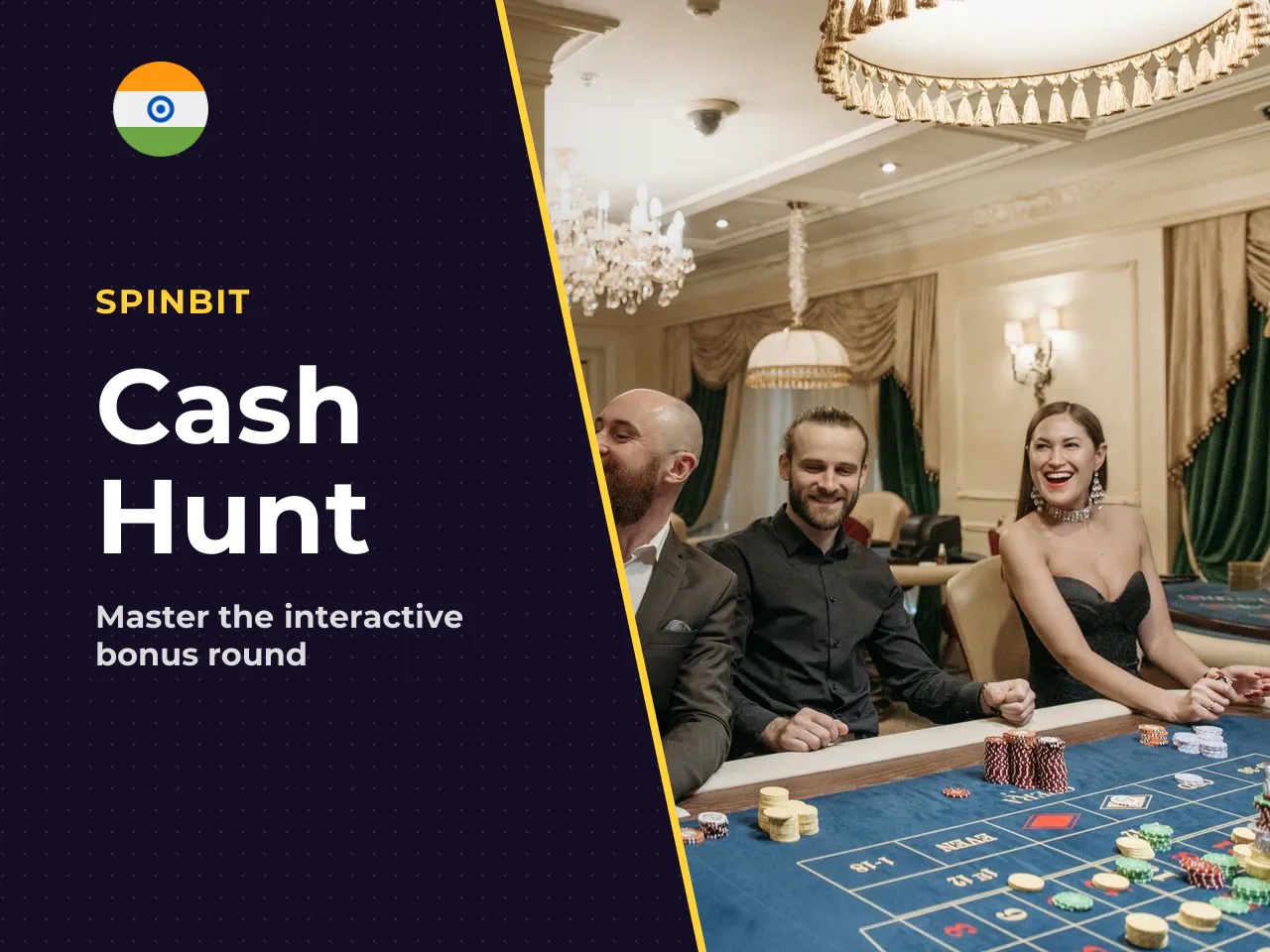
Cash Hunt is an interactive shooting gallery with a grid of 108 randomized multiplier symbols. Before the round starts, the screen shows all 108 values, covers them with digital symbols (stars, targets, hats), and shuffles the positions. Each player then aims a cannon at one cell before time expires. When the cannon fires, the revealed symbol shows the multiplier awarded to that player alone. If a Top Slot multiplier was triggered for Cash Hunt, it is applied to all 108 values before the symbols are covered, which is why a boosted Cash Hunt round is materially different from a standard one.
«Aggregated data places the median Cash Hunt payout near 100×, the mean at 159×, and the 90th percentile above 300×.» — Live-data aggregator, Crazy Time bonus payout statistics
Because every participant picks an independent cell, two players in the very same Cash Hunt round can walk away with wildly different multipliers. This is the only bonus where individual choice fully determines an individual result.
Coin Flip is the most frequent bonus round, sitting on four wheel segments. The interface generates two separate multipliers, one for the Red side and one for the Blue side of a physical coin. A mechanical Flipomatic device then flips it. Whichever face lands upward sets the multiplier for every participating player. Median payouts here are modest, often in the 5x to 15x band, yet a 50x Top Slot stacked on a 100x base outcome can spike to 5,000x. There is no decision to make in Coin Flip. The result is purely which side lands face up.
🪙 Rescue Flip Mechanic
If the random multipliers assigned to both the Red and Blue sides come out exceptionally low (say 2x and 3x), a hidden "Rescue Flip" feature may trigger automatically. The Flipomatic executes a second physical flip without any additional wager from participating players, generating a fresh pair of higher multipliers so the round meets minimum payout standards. In practice this cushions the worst-case Coin Flip outcome, but it is discretionary game logic, not something you can build a staking system around.
The Pachinko bonus uses a physical vertical wall studded with pegs above 16 landing slots along the bottom. The presenter climbs a ladder and drops a glowing puck from a randomly designated zone (slots 1 through 16) at the top. As the puck falls, it bounces off the pegs until it settles in a bottom slot marked with a multiplier or a DOUBLE label.
Land in a standard multiplier slot and that value settles the round. Land on DOUBLE and every multiplier value on the board is instantly doubled, the DOUBLE slot itself is replaced (in the regulated Pennsylvania rule set, with a 50x value), and the presenter drops the puck again from a random top zone. Successive DOUBLE landings compound multiplicatively. Published regulatory tables list base landing multipliers running from 2x to 400x, and the chain continues until it reaches the internal 10,000x Pachinko limit.
The Crazy Time bonus is the rarest and most volatile feature in the game, occupying a single red segment on the main wheel with a 1.85% hit chance. When it triggers, the presenter walks through a red door into a virtual studio housing a giant 64-segment virtual money wheel.
Before that wheel spins, qualifying players pick one of three coloured flappers at the top: Green, Blue, or Yellow. The presenter presses a red button, the wheel spins, and each player receives the multiplier aligned with their chosen flapper colour. The virtual wheel mixes numbers with DOUBLE and TRIPLE segments. If your flapper lands on DOUBLE or TRIPLE, every multiplier on the virtual wheel is doubled or tripled for holders of that colour only, and a respin follows for that colour. Through stacked respins, this bonus can reach internal multipliers up to 20,000x, subject to Evolution's global per-bet payout cap of 25,000x or local currency limits.
A true live crazy time demo with playable virtual currency does not exist, and the reason is simple: live production involves real hosts, real studios, and real broadcast costs. What you can access is spectator mode or a simulated demo widget, enough to observe live rounds, test interface controls, and study outcome cadence without spending anything.
Does spectator mode require registration? In most cases, partly yes. Independent hubs and third-party practice widgets built as browser recreations of the interface usually need no account at all, but they are not the Evolution broadcast. To watch the genuine live stream inside a licensed operator's lobby, most casinos want a registered, age-verified account, even though no deposit is needed to open the table in view-only mode. A minority of operators gate Crazy Time as real-money only, so the table will not open until a balance exists. Practical takeaway: expect to create a free account for authentic spectating, and expect zero deposit obligation at that stage.
«An experiment with 214 participants showed that a demo mode with inflated RTP significantly increased bet sizes when players transitioned to real-money play.» — Experimental study of social casino games and demo modes, 214 participants aged 18-45
This is the single most important research finding in the section. Free-play sessions that feel generous can measurably distort your real-money staking behaviour. Treat crazy time free access strictly as interface training, never as a performance preview. Responsible gambling standards published by the National Council on Problem Gambling point the same way: free or demonstration games should use the same payout percentages and odds as paid games, and should sit behind an account log-in so minors and self-excluded players cannot reach them.
In spectator or demo observation mode, you can review the functional layout of the game without risking funds. Watching a free session lets you verify:
| Game Aspect | What Spectator/Demo Mode Teaches | Limitations of Demo Mode |
|---|---|---|
| Betting window timing | The exact 12 to 15 second window before "No More Bets" locks the grid. | Does not replicate decision-making under real financial pressure. |
| Segment layout | Where numbers and bonus spots sit on the panel, and what a spread costs. | How stake size feels once chips represent real currency. |
| Top Slot multipliers | How alignment scales base numbers and bonus multipliers. | Cannot simulate bankroll drawdown across hundreds of spins. |
| Bonus game execution | Visual flow of Cash Hunt shuffles, Pachinko peg drops, flapper picks. | Small demo samples give a false impression of trigger frequency. |
| Interface mechanics | Autoplay setup, chip stacking, chat controls, stream quality toggles. | Demo credits carry zero cash value and cannot be withdrawn, ever. |
| Bet combinations | Cost of single bets, spreads, and full cover-all coverage per round. | Bankroll discipline and loss-chasing pressure under real exposure. |
A practice session in which a bonus lands three times in fifty spins proves nothing about the next fifty. Variance is random and independent across sessions. A streak in the log is a record, not a signal.
Before committing real funds, run this 20-round observation plan in spectator or practice mode.
Review step: after the 20 rounds, write down how many rounds returned nothing, your total virtual outlay, and your net position. That short review is what separates a learning session from background clicking. If real-money play follows, set a deposit limit before the first deposit, not after.
The gap between demo observation and crazy time real money play comes down to three things: financial risk, account authentication, and cashout capability. Demo play uses display-only chips or view-only access with zero cash value. Real money participation requires a verified account with a licensed operator, identity verification (KYC), and a funded balance, in India usually INR via UPI or NetBanking. Technically, most free widgets are local browser recreations that share no state with any live table, while operator demo mode, where it exists, streams the genuine broadcast with display-only chips.
⚠️ RISK WARNING AND RESPONSIBLE GAMBLING Demo outcomes and free spectator sequences carry zero financial weight and cannot predict future real-money results. Live game shows run on strict random probabilities, and each spin is independent. Never treat practice sessions as training for guaranteed profit. Set strict deposit and loss limits before switching to real-money play. NICE guideline NG248 on identifying and managing gambling-related harms, alongside national helplines and self-exclusion registers, exists precisely because escalation from free play to real stakes is a documented pattern.
ℹ️ Disclaimer: this information is general in nature and does not replace professional advice. Online gambling is regulated differently across jurisdictions, so verify the legislation applicable in your state or country before registering, depositing, or withdrawing funds.
Choosing a crazy time casino for real-money play means checking the boring things first: licensing credentials, payment compatibility for Indian users (INR support, UPI, NetBanking), bonus terms, and withdrawal processing rules. The wheel is the same everywhere. The payout policy is not.
Pre-deposit verification checklist
| Method | Typical Deposit Minimum | Typical Withdrawal Speed | Fees | Practical Notes |
|---|---|---|---|---|
| UPI (direct VPA) | ₹500 | 15 minutes to 2 hours (automated) | Usually none from the operator | Fastest and most widely supported; the VPA name must match the account name. |
| PhonePe / Google Pay / Paytm | ₹500 to ₹1,000 | 30 minutes to 6 hours | Usually none | App-based UPI rails; occasional gateway downtime during bank maintenance. |
| NetBanking / IMPS | ₹1,000 | 6 to 24 hours | Occasional bank charges | Better for larger amounts; needs exact IFSC and account details. |
| Bank wire / NEFT | ₹1,000+ | 24 to 72 business hours | Possible processing fee | Slowest route; weekend requests queue until the next business day. |
| Crypto (where legally available) | Variable | Minutes to hours | Network fee | Volatile value plus extra legal and tax considerations; not suitable for everyone. |
All figures above are typical operator-dependent ranges, not fixed guarantees. Always confirm limits, fees, and timelines in the cashier and terms of the specific site you use.
Picking a reliable site for crazy time online play comes down to four operational checks before you register or transfer money.
«The Michigan Gaming Control Board requires prior approval, on-site inspection, and compliance with responsible gaming standards for all live dealer providers.» — Michigan Gaming Control Board, internet gaming regulatory requirements
So regulatory oversight of live dealer content is not theoretical. In mature markets the studio, the wheel, and the RNG components are each approved before a single spin reaches players. The UK Gambling Commission likewise requires holders of gambling software and remote operating licences to meet remote technical standards and testing procedures under licence condition 2.3.1.
On payout speed claims. Payout timing depends on the payment rail and the verification state of the account, not on marketing promises. Operators running automated UPI payouts to fully verified accounts often resolve small cashouts, say ₹5,000, within minutes to a couple of hours. Operators relying on manual bank-wire review can push approval into a 24 to 72 hour window, especially over a weekend when document queues build up. Because these timings vary by operator, bank, and request size, treat them as ranges to verify in the terms rather than a benchmark you can lean on. And complete KYC before you need the money.
«Before you deposit, check the withdrawal rules and bonus terms. A high headline multiplier means very little if high wagering requirements, low max-cashout caps, or payment friction block your payout.» — Nisha Rao, Content Editor at Casino and Betting India
Casino bonuses love a big headline match percentage. Their real value for live game show players, though, depends almost entirely on game contribution weighting. In most promotional terms, wagering contribution for live games such as Crazy Time drops to 5% or 10%, sometimes 0%, against 100% for standard video slots.
Where these numbers come from. Contribution weightings are operator-specific terms, not a property of the game itself. Regulators require bonus offers to spell out wagering requirements, eligible games, validity periods, and forfeiture rules, which is exactly why the percentage must appear in the promotion's T&Cs. Before claiming, find three lines: the live-casino contribution percentage, the maximum bet permitted while a bonus is active, and the maximum cashout from bonus winnings. If any of the three is missing, the offer is unquantifiable. Decline it.
Here is what the maths looks like. A player claims a 100% match up to ₹10,000 with a 30x wagering requirement on a live casino promotion weighted at 10%. The effective requirement rises tenfold. Instead of wagering ₹300,000 on slots, that player must place ₹3,000,000 in total wagers on Crazy Time before bonus funds or related winnings become withdrawable. Against a house edge of roughly 4% per round, that is mathematically punishing.
Always check maximum bet rules while a bonus is active, because breaching a stated per-round cap can forfeit the bonus balance and everything won from it. Published caps commonly sit around ₹400 or $5 per spin, but the exact figure is operator-defined and belongs in the T&Cs. One protection worth knowing: under UK Gambling Commission rules, players must be able to withdraw their own deposit balance at any time, including while a bonus is pending or active, except where a specific regulatory obligation applies. Equivalent protections do not exist in every jurisdiction, so read the terms tied to the licence your operator actually holds.
Search suggestions push the phrase crazy time bonus buy fairly often, so it deserves a straight answer. No. There is no feature that lets you purchase entry into Coin Flip, Cash Hunt, Pachinko, or the Crazy Time bonus. Bonus buy mechanics belong to certain RNG video slots, where the software can spawn a feature round on demand for a fixed price. Crazy Time cannot work that way, because the trigger is a physical wheel spun once per round for everybody watching.
Your only route into a bonus round is a placed wager on that specific bonus spot before "no more bets", and then the wheel has to land there. Any site, chat group, or APK advertising a paid bonus-buy shortcut for this game is either describing a different product or trying to take your money. Worth remembering when a promotion sounds too clever.
ℹ️ Disclaimer: the following is general information, not legal or tax advice. Indian gambling and taxation rules are state-specific and change frequently. Consult a qualified legal or tax professional before playing for real money or filing returns on winnings.
For Indian readers the legality question sits before every other consideration in this guide, which is why it belongs in the main text rather than buried in an FAQ accordion.
1. State law is the deciding factor. India regulates gambling primarily at state level, and the picture is genuinely fragmented. Some states operate licensed physical and regulated gaming frameworks (Goa, Sikkim, Daman), while others have enacted express prohibitions on real-money online gaming and have historically restricted or blocked such activity, among them Telangana, Andhra Pradesh, Assam, Odisha, Nagaland, and Tamil Nadu, several of these subject to ongoing litigation. Central-level frameworks, including the Promotion and Regulation of Online Gaming Act context and prior IT intermediary rules, have tightened national monitoring of real-money gaming operations. Verify your own state's current position before depositing.
2. Tax on winnings is withheld at source. Under India's income-tax framework for online gaming (Section 194BA and 115BBJ context), net winnings from online games are taxable at a flat 30%, with tax deducted at source (TDS) on withdrawal or at the end of the financial year on the closing balance, plus applicable cess. There is no minimum threshold exemption of the kind that once applied. Practical implications:
3. Payment and account-freeze risk. This is the most under-reported practical risk for Indian players.
Red-flag checklist before you deposit from India:
ℹ️ Disclaimer: this information is general in nature. RTP is a theoretical figure calculated over millions of spins and does not guarantee any result in an individual session.
Overall theoretical RTP for Crazy Time spans 94.33% to 96.08%, which puts the house edge between 3.92% and 5.67%, depending on how you distribute wagers across the board.
RTP (Return to Player) describes long-term mathematical expectation calculated over millions of spins. The values Evolution publishes per bet spot look like this:
«RTP values are confirmed by independent eCOGRA auditing; the number 1 bet is fixed at 96.08% and Pachinko at 94.33%.» — Independent technical review, eCOGRA audit confirmation (early 2026)
The same figures appear in published rule sheets used by state-owned operators, including the Loto-Québec Crazy Time rules document, which is the most accessible primary-style source if you want to verify the table yourself.
Since number bets carry the higher RTP values, backing Number 1 exclusively gives the lowest theoretical house edge on the board. Weighting your stakes toward Pachinko or the Crazy Time bonus does the opposite: lower statistical return, much higher volatility. Bet limits, by the way, are operator-defined; documented ranges run from roughly £0.10 minimum to £2,500 maximum per segment, varying by site and currency.
No betting system beats the mathematical house edge built into Crazy Time. Strategy frameworks change your risk exposure and variance profile, nothing more, because every single bet spot carries negative expected value ($EV < 0$). If you still intend to play for stakes, do it through a licensed online casino with published terms and working responsible-gambling tools.
According to documentation published by the Pennsylvania Gaming Control Board, live gaming wheels operate under certified independent mechanical and randomness standards.
«Every wheel spin is statistically independent: past results have no influence on the probability of the next outcome.» — Pennsylvania Gaming Control Board, live gaming wheel certification documentation. https://gamingcontrolboard.pa.gov/
A guaranteed win would require at least one staking mix with positive expected value across every possible outcome. Since no published bet on the Crazy Time board has an RTP above 100%, no staking pattern, flat, progressive, proportional, or full-coverage, removes the negative expectation. Treat the game as paid entertainment with a known cost per hour, and the maths stops being disappointing.
Crazy Time mobile play is fully supported: adaptive HTML5 video streams to smartphones and tablets, with recent spin results visible through real-time interface trackers.
The game runs directly inside mobile browsers (Safari, Chrome) and inside operator casino apps on iOS and Android. Evolution's mobile interface reframes the broadcast, keeping the Top Slot and main wheel centred while placing touch-friendly betting grids along the bottom of the screen.
«81.5% of online players use a mobile phone as their primary gambling device.» — Commonwealth of Pennsylvania, 2023 Online Gambling Report
That share explains why the mobile layout, not the desktop one, is now the reference implementation for live game shows. For four players out of five, the phone screen is the game.
Stream delivery uses adaptive bitrate technology, scaling resolution from 1080p HD down to 240p on unstable connections to keep the picture moving during an active spin. For Indian mobile users on 4G or 5G, stable Wi-Fi is the safer choice during real-money play, mainly to avoid a connection drop inside a critical decision window such as a Cash Hunt aim or a Crazy Time flapper pick. One honest caveat: independent, quantified benchmarks of bet-placement usability and stream stability are not publicly available, so vendor claims of "smooth" mobile play are promotional rather than measured.
🚩 RED FLAGS: fake apps, "predictor" APKs, and signal channels
Evolution Gaming does not publish a standalone consumer Crazy Time app. The game is only accessible inside a licensed operator's app or mobile browser lobby. Treat the following as high-risk by default:
- "Crazy Time App APK" and "Crazy Time Mod APK" downloads from file-sharing sites or Telegram. Side-loaded APKs commonly request SMS, contacts, and accessibility permissions, exactly the permission set used to intercept banking OTPs.
- "Crazy Time Predictor" software, bots, and paid signal groups. These cannot work. The base outcome is a physical wheel spun in a studio, and the digital layers (Top Slot pairing, Cash Hunt multipliers) run on certified RNGs. Each spin is independent, so no history, pattern, or algorithm forecasts the next segment. Any product claiming otherwise is selling a guarantee it cannot deliver.
- "Hack", "trick", or "100% winning formula" claims, including screenshots of alleged wins, which are trivially fabricated.
- Third-party "cricket ID / gaming ID" resellers who take your money via personal UPI and hand you a login on someone else's account. No ownership, no KYC record, no payout recourse.
Safe pattern: install only the operator's app from its official website or the official store listing, verify the licence, and never grant SMS or accessibility permissions to a gambling app.
The Crazy Time interface shows a running history of recent results, usually the last 21 outcomes, alongside bonus frequency statistics over selectable timeframes such as 1 hour, 24 hours, or 7 days. Third-party tracking sites aggregate the same feed and add parameters like "longest dry spell for Pachinko" or "average multiplier hit in Cash Hunt", typically with filterable windows from 1 to 72 hours, timestamps, segment frequency, and drought counters.
Data provenance across these trackers is inconsistent. Some claim official API feeds, others describe scraping a connected results stream, so treat their sample sizes and update lags as declared rather than verified. The better tracker pages state the limitation themselves: the tables describe history, they do not predict the next spin.
Retrospective data is interesting, and it can teach you the cadence of the game. But past statistics cannot predict future outcomes. Saying a bonus is "due" because it has not hit in 50 spins is textbook gambler's fallacy. Every spin keeps the identical fixed probabilities set by the 54 physical segments on the wheel.
| Game Title | Developer | Overall RTP Range | Max Win Multiplier Cap | Core Game Mechanics |
|---|---|---|---|---|
| Crazy Time | Evolution Gaming | 94.33% to 96.08% | 25,000x ($500,000 limit) | 54-segment wheel, Top Slot, four interactive bonus rounds. |
| Dream Catcher | Evolution Gaming | 90.57% to 96.58% | 20,000x (multiplier spins) | Classic 54-segment money wheel, no bonus mini-games. |
| Monopoly Live | Evolution / Hasbro | 91.30% to 96.23% | 10,000x ($500,000 limit) | Money wheel plus a 3D augmented reality board-game bonus. |
| Funky Time | Evolution Gaming | 95.38% to 95.99% | 10,000x | 64-segment DigiWheel with Digi-Spin multipliers and four bonuses. |
Read this table as a volatility map, not a ranking. Dream Catcher is the simplest and fastest of the group because it has no bonus rounds at all, which suits players who dislike sitting through droughts. Monopoly Live trades wheel speed for a longer AR bonus that can run several minutes. Funky Time swaps the physical wheel for a digital DigiWheel, tightening the RTP band while lowering the ceiling. Crazy Time sits at the high-variance end: widest RTP spread, highest cap, most bonus branching per round.
If you decide to go further, the calm order of operations is simple: read the licence, read the bonus terms, set a limit, then watch a few rounds in view-only mode before any money moves. There is no rush, and no deposit is required to learn how this game behaves.
This article is informational and does not constitute legal, tax, or financial advice. Gambling involves a risk of financial loss. 18+ only. If gambling stops being entertainment, contact a national helpline or use your operator's self-exclusion tools.