Dragon Tiger Online: Rules, Demo Play, and Live Casino Strategy

Author: Nisha Rao, Casino Content Editor, Casino and Betting India · Last updated: 2026 · For readers aged 18+ (21+ in some states and jurisdictions)

Provider

Evolution

RTP

96.27%

Volatility

Medium

Max win

50x
Dragon Tiger Online Rules, Demo Play

Quick Takeaways

  • The game in one line:one card goes to Dragon, one card goes to Tiger, and the higher rank wins. Ace is the lowest card, King is the highest, and suits are ignored on main bets.
  • Best mathematical value:main Dragon/Tiger bets carry a 3.73% house edge under standard 8-deck rules with the 50% tie-loss rule.
  • Worst value:the Tie bet at an 8:1 payout carries a 32.77% house edge. Suited Tie at 50:1 sits at 13.98%, while Big/Small and Odd/Even side bets sit near 7.69%.
  • The "7" rule:on most layouts, if the dealt card is exactly a 7, Big, Small and Suit side bets lose automatically.
  • Tie payouts vary by provider:11:1 (Evolution, Pragmatic Play), 10:1 (Playtech and several land-based rulebooks), 8:1 (some Ezugi and legacy rule sets).
  • Demo first:RNG and First Person versions let you learn the interface for free, with the same certified RTP as real-money play.
  • Bonus reality check:live casino games usually contribute only 5 to 20% toward wagering. That can turn a ₹10,000 bonus at 30x into ₹3,000,000 of real turnover.
  • India context:the Promotion and Regulation of Online Gaming Act 2025, state-level bans, and a 28% GST on chip or coupon purchases all affect real-money play.
Quick Takeaways

What This Guide Covers

This is a rules-and-risk guide, not a promo page. In order, it walks through the game format, the three main outcomes, side bets and the odd little "7" rule, a full round walkthrough, card ranking, tie mechanics, live versus RNG tables, provider payout differences, how to read the roadmaps, demo access, the real-money checklist for India, bonus contribution maths, strategy limits, similar card games, a plain-English glossary, an FAQ, and responsible gambling tools.

Read the parts you need. Skip the rest.

Dragon Tiger is a minimalist two-card comparison game. Its modern form is widely traced by casino operators and industry guides to South-East Asia, most often to land-based casinos in Cambodia, and it has grown into one of the most popular live dealer titles across Asian and global online gaming platforms. Origin claims here are attributions from operator and industry sources rather than documented archival history. Read them as the accepted market narrative, not a verified date-and-place record.

The objective is straightforward. Two cards are dealt face-up, one to the Dragon position and one to the Tiger position, and the hand with the higher card rank wins the round. That is the whole game.

Dragon Tiger is a minimalist two-card

«Before you deposit, check the withdrawal rules and game contribution rates. Dragon Tiger is a fast game of pure chance, where clarity on odds and disciplined limits matter far more than chasing big promotional offers.» Nisha Rao, Casino Content Editor, Casino and Betting India (source: editorial brief)

What is Dragon Tiger and How It Differs from Other Casino Games

Dragon Tiger is a fast-paced card game where a single card dealt to the Dragon position competes against a single card dealt to the Tiger position, purely on numerical rank. Unlike poker or blackjack, the dragon tiger game requires no secondary decisions, no hand building, and no complex drawing rules after the bet is placed. There is no hitting, standing, splitting, doubling, bluffing or third-card logic. Once the betting window closes, the outcome is already sitting in the shoe.

+-------------------------------------------------------------------+
|                        LIVE DEALER POSITION                       |
|                     [ Card Shoe & Discard Tray ]                  |
+-------------------------------------------------------------------+
|                                                                   |
|   +-----------------------+               +-------------------+   |
|   |      DRAGON BOX       |               |     TIGER BOX     |   |
|   |   [ Dealt Card #1 ]   |               | [ Dealt Card #2 ] |   |
|   +-----------------------+               +-------------------+   |
|                                                                   |
|   +-----------------------------------------------------------+   |
|   |                         TIE BOX                           |   |
|   |                  (Pays 8:1 / 10:1 / 11:1)                 |   |
|   +-----------------------------------------------------------+   |
|                                                                   |
|   +-----------------------------------------------------------+   |
|   |                    SUITED TIE BOX                         |   |
|   |                       (Pays 50:1)                         |   |
|   +-----------------------------------------------------------+   |
|                                                                   |
|   +-----------------------+               +-------------------+   |
|   |  DRAGON SIDE BETS     |               |  TIGER SIDE BETS  |   |
|   |  Big / Small / Suit   |               | Big / Small / Suit|   |
|   +-----------------------+               +-------------------+   |
+-------------------------------------------------------------------+
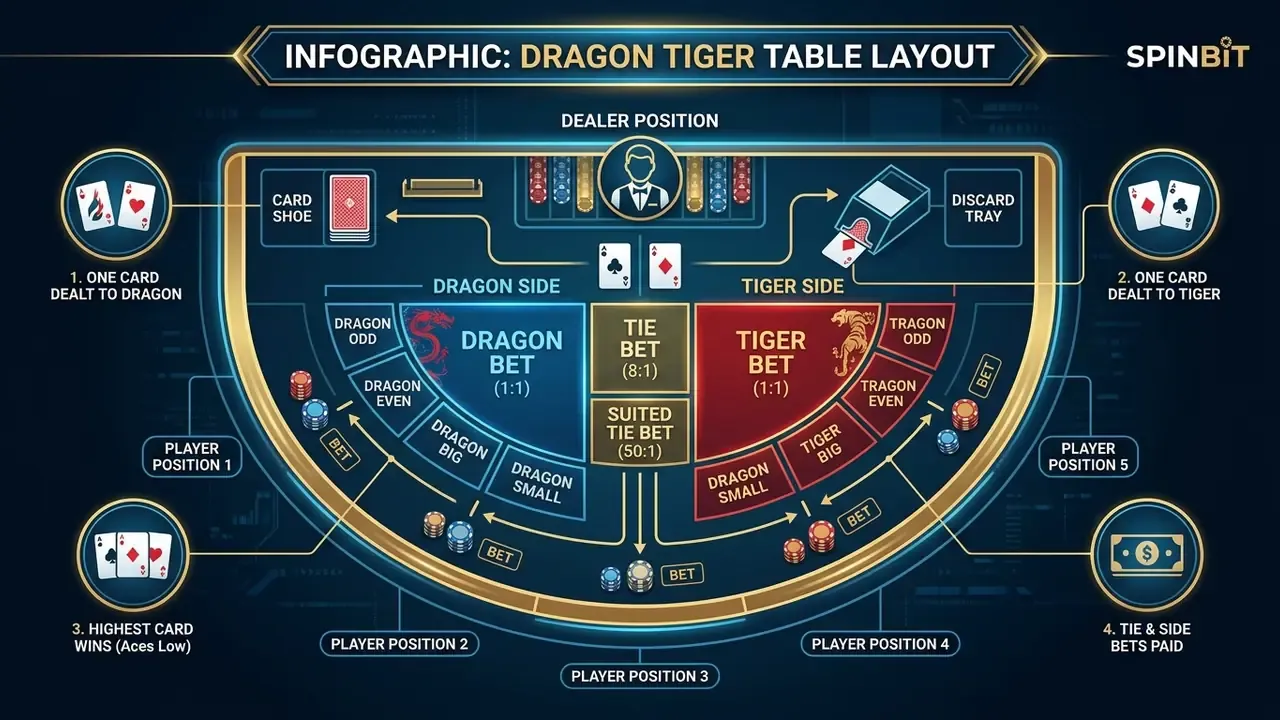
Dragon Tiger game: Dragon, Tiger, Tie and side bet zones
  • Purpose: Instantly explains the mechanics to a user opening a dragon tiger game for the first time.
  • Semantic markup rules: Image with alt text "Dragon Tiger game: Dragon, Tiger and Tie betting zones". A text transcription is exposed in the DOM as a structured description: top area, dealer and card shoe; central blocks, Dragon (left) and Tiger (right); middle block, Tie and Suited Tie; lower areas, additional side bet functionality (Big/Small, Suit).

In a typical online setup, the physical or virtual table layout shows clearly separated betting zones for Dragon, Tiger, Tie, and optional side bets. Official regulatory rule sets, such as the Dragon Tiger rules approved by the Gambling Regulatory Authority of Singapore, define these betting areas separately. That is why layouts look broadly similar across licensed operators even when payout tables differ.

The simplicity of the layout means a new player can read the entire table in seconds and settle a round in well under a minute. One decision point, fast turnover, almost no rules overhead. That mix is the most commonly cited reason Dragon Tiger shows up in the "popular" and "trending" tabs of live casino lobbies. Preference data by player segment is not published by providers, though, so treat popularity claims as market observation rather than measured audience research.

- Purpose Instantly explains the mechanics

Dragon, Tiger and Tie: Which Outcome You Bet On

In Dragon Tiger, players back one of three primary outcomes: Dragon winning, Tiger winning, or both cards ending in a Tie. A main wager on Dragon or Tiger pays even money (1:1) if the chosen side receives the higher card rank.

Outcome TypeWinning ConditionStandard PayoutTheoretical ProbabilityBase House Edge
Dragon BetDragon card rank > Tiger card rank1:146.27%3.73%
Tiger BetTiger card rank > Dragon card rank1:146.27%3.73%
Tie BetDragon card rank = Tiger card rank8:1 / 10:1 / 11:17.47%32.77% (at 8:1), ~13.16% (at 11:1)
Suited Tie BetEqual rank AND matching suit50:11.69%13.98%
Big (8 to K)Dealt card rank is 8 or higher1:1~46.2%~7.69%
Small (A to 6)Dealt card rank is 6 or lower1:1~46.2%~7.69%
SuitDealt card matches the chosen suit3:1~23.1%~7.69%

«Dragon and Tiger each win roughly 46.26% of rounds, while a tie occurs in about 7.47% of hands from an eight-deck shoe.» Betting Data Lab, independent quantitative analysis of Dragon Tiger, "Comparative Table of House Edge Across Bet Types" (research corpus)

When both cards share the exact same rank, the round is declared a Tie. Under standard regulatory rulebooks, such as those issued by the Gambling Regulatory Authority of Singapore (MBS Rules), main bets on Dragon and Tiger lose 50% of their stake on a Tie result, while the dedicated Tie bet wins at statutory table odds. This half-loss rule is exactly what pushes the main-bet house edge from a theoretical coin flip up to 3.73%.

Side Bets Explained: Big, Small, Odd/Even and Suit

Most live and RNG Dragon Tiger tables add optional side bets. These resolve on the individual card dealt to a chosen position, not on the Dragon-versus-Tiger comparison. They settle independently of the main outcome, so a Dragon bet can win while a Big bet on the same card loses. Slightly counterintuitive at first, then obvious.

Side Bets Rules (Big / Small / Suit and the "7" rule):

  • Big Bet: wins if the dealt card rank is 8 or higher (8, 9, 10, J, Q, K). Pays 1:1.
  • Small Bet: wins if the dealt card rank is 6 or lower (A, 2, 3, 4, 5, 6). Pays 1:1.
  • The "7" Rule: if the dealt card is exactly a 7, all Big and Small bets instantly lose to the house. Seven is the neutral centre card of the ranking scale, and this single exception is the entire source of the house advantage on these wagers.
  • Suit Bet: a wager that the dealt card will be Spades, Hearts, Clubs or Diamonds. Pays 3:1. On most rule sets, a dealt 7 also causes Suit bets to lose.
  • Odd / Even Bet: where offered, this wager predicts whether the card rank is odd or even. House rules again treat certain ranks (typically the 7, and in some variants the Ace) as automatic losers.

«Big, Small, Odd and Even side bets carry a house edge of roughly 7.69%, about double the edge on main Dragon/Tiger wagers.» Betting Data Lab, analysis of Dragon Tiger side bets, "Side Bets: Big/Small, Odd/Even" (research corpus)

In practice, side bets look attractive because they pay even money or 3:1 on a single card. Over time, though, they cost you roughly twice as much per unit staked as simply backing Dragon or Tiger. Same table, double the price.

Dragon Tiger Rules: Step-by-Step Round Walkthrough

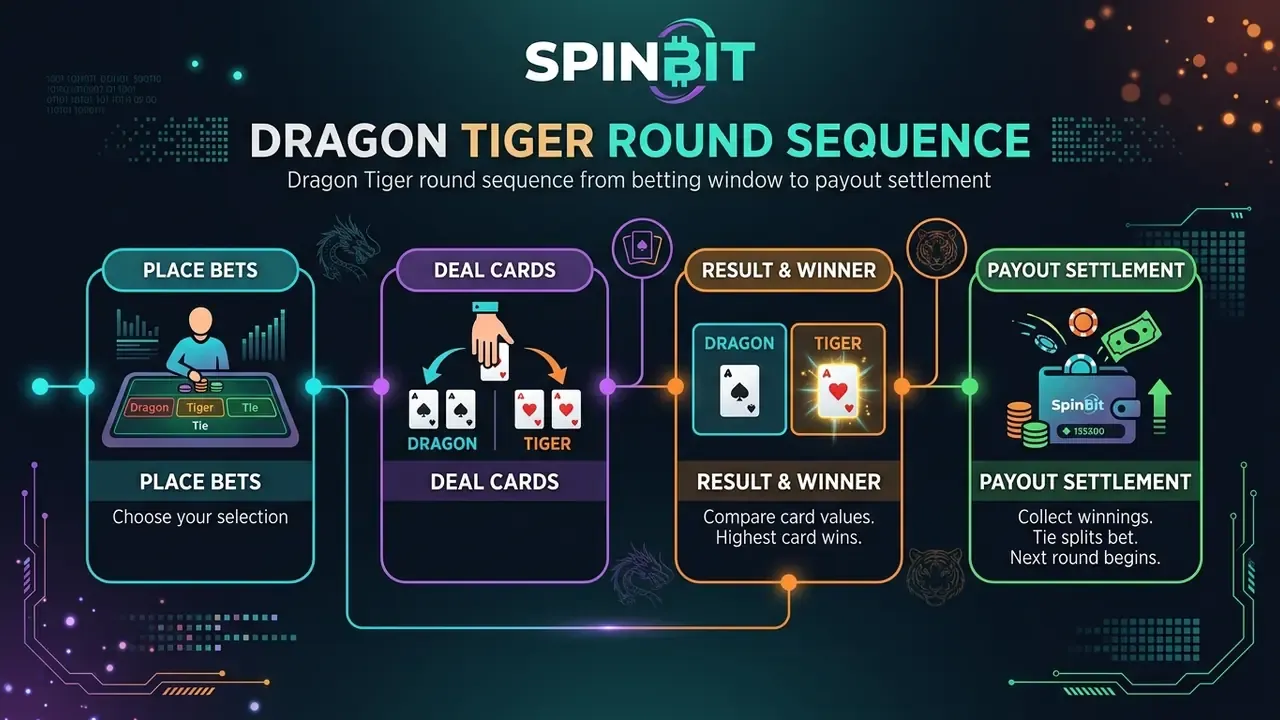
1
Opening Bets: The dealer or software opens the betting phase with the signal "Place your bets, please."
2
Bet Selection: Players select chip values and place wagers on Dragon, Tiger, Tie, or available side boxes.
3
Closing Bets: The countdown expires, the dealer announces "No more bets," and all interactive interfaces lock.
4
Card Burn and Deal: The dealer burns one card (per operational house rules), then deals one card face-up to Dragon, followed by one card face-up to Tiger.
5
Comparison: Card ranks are compared immediately, from Ace (lowest) to King (highest).
6
Outcome Declaration: The system or dealer identifies the winning side or declares a Tie.
7
Settlement: Losing bets are collected, winning main bets receive 1:1 payouts (or 50% returned on a Tie), and Tie and side wagers are paid according to the paytable.
Dragon Tiger round sequence from betting window to payout settlement

Card Ranking and Determining the Winner

Card ranking in Dragon Tiger is absolute and sequential. Ace is the lowest card (value 1), King is the highest (value 13). Suit values do not influence the outcome of main Dragon or Tiger wagers.

The full card hierarchy is structured as follows:

$$\text{Ace (1) < 2 < 3 < 4 < 5 < 6 < 7 < 8 < 9 < 10 < Jack (11) < Queen (12) < King (13)}$$

If Dragon draws a Queen (12) and Tiger draws an 8, Dragon wins instantly. Flip it around: if Tiger shows a Jack and Dragon shows a 4, every wager on Tiger is paid at 1:1. Suits (Spades, Hearts, Clubs, Diamonds) are completely ignored during main hand comparisons. A King of Diamonds and a King of Spades carry identical rank value, so the round is a Tie regardless of suit colour or style.

Card Ranking and Determining the Winner

Tie Bet and Suited Tie Bet in Dragon Tiger

The Tie Bet and Suited Tie Bet are specialised side wagers built to offer higher payout multiples when both positions receive matching card values. A standard Tie Bet wins when both cards share an identical rank, returning 8:1, 10:1 or 11:1 depending on the provider's rule set.

Suited Tie wagers require both cards to match in rank and suit, for example two six of Hearts dealt from an 8-deck shoe. A Suited Tie pays 50:1, yet quantitative breakdowns published by Wizard of Odds put its house edge at 13.98%. Standard Tie bets at an 8:1 payout are steeper still at 32.77%. Compared with the 3.73% edge on main wagers, both are high-variance choices, and the 50:1 headline number is doing a lot of persuasive work.

Tie Bet and Suited Tie Bet

«At an 8:1 payout the house keeps roughly 32.77 units of every 100 wagered on Tie, one of the worst returns available on the table.» Wizard of Odds, mathematical analysis of Dragon Tiger, "Probability of Outcomes and House Edge on Main Bets". https://wizardofodds.com

One useful detail: if you back Dragon or Tiger and the round ends in a Tie or Suited Tie, half of your main stake comes back rather than vanishing in full. That rule is confirmed both by Evolution's published Dragon Tiger Live rules and by regulatory rulebooks.

Dragon Tiger Live Dealer vs Virtual RNG Version

The main difference between a dragon tiger live dealer stream and a virtual RNG game sits in three places: deal execution, pacing, and social presentation. A live dealer table is broadcast in real time from a professional studio, using physical card shoes and human dealers. Virtual RNG versions use certified algorithms to calculate outcomes instantly.

Live gaming studios, including Pragmatic Play and Evolution (which also operates First Person Dragon Tiger), run rounds on fixed timed intervals, typically 15 to 30 seconds per hand. Provider documentation and studio round-duration data place the average Dragon Tiger round at roughly 25 seconds, inside that 15 to 30 second band. If you are comparing formats across a whole lobby, our editorial overview of live casino formats explains how studio streams, First Person modes and hybrid tables are built.

Virtual dragon tiger games work differently. You control the dealing speed, pause play, or review transaction histories without a countdown clock breathing down your neck. Minimum limits for live tables generally start around €1 ($1 or the equivalent on INR and UPI-friendly platforms), with maximums commonly capped near €5,000. RNG titles often accommodate micro-stakes instead, and some listings begin as low as $0.20.

Interface features worth knowing before you sit down:

Dragon Tiger Live Dealer vs Virtual
  • Autoplay:live platforms let you pre-select a chip size and run a set number of automatic rounds, commonly up to 50 to 100 consecutive hands, with stop-loss and stop-win triggers.
  • Saved favourite bets:immersive live lobbies allow players to store repeat bet patterns. Betway's Evolution-powered lobby, for example, supports saving up to 15 favourite bets.
  • Multi-camera immersive view:switchable camera angles and full-screen card close-ups. Pragmatic Play tables also integrate a side-by-side baccarat view in some lobbies.
  • Live chat:text chat with the dealer and the table, useful for confirming a rule or a payout question in real time.
  • Full statistics panel:every major provider exposes historical results and trend roads directly in the UI (see the roadmap section below).
  • Light-sync and studio effects:Evolution's Dragon Tiger studio synchronises lighting to outcomes. Presentation, not mechanics.
Spinbit heading-banner

Provider Comparison: Where Payouts and Rules Differ

ProviderMain Bet PayoutTie PayoutSuited Tie PayoutUnique UI Features
Evolution1:1 (50% returned on Tie)11:150:1Light-sync effects, First Person RNG mode with "GO LIVE" switch
Pragmatic Play1:1 (50% returned on Tie)11:150:1Multi-camera angles, integrated baccarat view, live and RNG twin releases
Ezugi1:1 (50% returned on Tie)8:1 or 11:1Not always offeredLocalised Asian dealers, native-language chat options
Playtech1:1 (50% returned on Tie)10:150:1Progressive side-jackpot integrations
Land-based rulebooks (e.g. Deltin, MBS versions)1:1 (50% returned on Tie)10:1 or 11:150:1 where offeredPhysical shoe of 6 to 8 pre-shuffled decks

The practical takeaway: a Tie bet is not one bet with one price. At 11:1 the house edge is roughly 13.16%. At 10:1 it is around 17.8%. At 8:1 it balloons to 32.77%. Open the in-game paytable (the "i" icon) before placing a Tie wager, because the same game name can hide three very different prices.

How to Read Dragon Tiger Live Statistics (Roadmaps)

Modern live platforms (Evolution, Pragmatic Play, Ezugi) display real-time trend charts above or beside the betting grid. Learning to read them is useful for orientation and record-keeping. Not for prediction.

  1. Bead Plate (Bead Road): shows exact historical results sequentially, filling from top-left downward and then moving right. Red marks Dragon wins, blue marks Tiger wins, green marks Ties.
  2. Big Road: tracks streaks. Consecutive wins by the same side continue down one column, and when the outcome changes a new column starts to the right. Ties usually appear as a green slash across the last result.
  3. Derived Roads (Big Eye Boy, Small Road, Cockroach Pig): pattern-derived indicators used by experienced Asian table players to judge whether a shoe is "choppy" or "streaky". They are calculated from the Big Road, not from the cards themselves.
  4. Bet counters and percentage bars: most interfaces also show how many rounds in the current shoe went Dragon, Tiger or Tie.

Important caveat: roadmaps summarise the past. They do not change the probability of the next round, because each hand is dealt independently from a multi-deck shoe. A road showing eight straight Dragon results does not make Tiger more likely on hand nine. It just looks like it should.

How to Read Dragon Tiger Live

Dragon Tiger Demo: How to Play Free Before Betting

A dragon tiger demo mode lets you experience the full game interface, testing rules and mechanics with renewable virtual credits instead of real funds. RNG-based versions, such as Evolution's First Person mode, replicate the live game's visual layout, rules and mathematical odds without financial risk. Free-play aggregators also host standalone RNG Dragon Tiger titles from smaller studios, reloading your play-money balance whenever it runs out, with no registration or download.

Where to find the demo button: in most casino lobbies, hovering or long-pressing a game tile reveals a secondary "Demo" / "Play for Free" / "Try" button beside the main "Play" button. In provider showcases and Evolution's First Person titles, the free flow launches from the game page and includes a "GO LIVE" button that moves you to the real live table. If a title only offers a single "Play" button, it is almost certainly a live-dealer stream, and therefore real-money only.

Dragon Tiger Demo How to Play

⚠️ ALERT BOX: Demo vs. Real Money Realities

  • RTP Parity: In regulated environments, demo RNG software uses the same Return-to-Player (RTP) algorithms as real-money modes. Demo play does not feature inflated win rates. Claims in some affiliate guides that demo RTP runs 2 to 10 percentage points higher contradict regulated technical standards.
  • Psychological Shift: Free play removes loss aversion. A player betting virtual credits feels no risk friction, whereas real-money play brings emotional pressure and a visible account balance.
  • Live Availability: Free demo play is generally restricted to RNG and virtual tables. Live dealer streams typically require a registered account and an active real-money balance to join or view.
  • Provider Coverage: Demo access is not uniform. Some studios publish free versions of nearly every title, others restrict demos to selected games or block them entirely in certain jurisdictions.

«Free play removes the emotional weight of losses and encourages faster, less considered betting than real-money sessions.» Online casino educational materials, "Psychological and Behavioural Differences Between Demo and Real-Money Play" (research corpus)

«Removing free credits entirely reduced casino visitation by roughly 20% without changing players' actual spend.» UNLV Harrah College of Hospitality, study on the impact of free-play promotions (research corpus)

Choosing to play dragon tiger demo first is a practical step, not a beginner's crutch. It lets you test software responsiveness on mobile, review side-bet mechanics, confirm which Tie payout your provider uses, and watch how the half-loss tie rule settles before any money is involved. It is also the cheapest way to find out whether a 15 to 30 second round cycle suits your pace or feels uncomfortably fast. For plenty of readers, honestly, it feels fast.

Dragon Tiger Real Money: What to Check Before Playing at a Casino

Disclaimer: This information is general in nature and does not replace professional advice. Online gambling is regulated by the laws of your own jurisdiction. Verify the legal status of real-money play in your state or country before registering on any platform. Gambling involves financial risk; 18+ (21+ where applicable).

Moving to dragon tiger real money calls for a systematic look at safety signals, withdrawal rules and legal parameters. In India, real-money online gaming falls under the Promotion and Regulation of Online Gaming Act 2025 and subsequent rules, which restrict online money games and their advertising nationwide. Several states, including Telangana and Andhra Pradesh, also maintain their own long-standing prohibitions on online money gaming. Access can therefore be blocked or unlawful even where a platform holds an offshore licence. Check the platform, then check your own local position, before any deposit.

[ ] 1. Valid Regulatory License: Verified active registration (e.g., Curaçao LOK, MGA, or state-approved authority).
[ ] 2. India Accessibility & Legal Status: Clear terms regarding jurisdiction compliance, state-level bans and local access rules.
[ ] 3. Identity & KYC Controls: Transparent age verification and identity checks required prior to first withdrawal.
[ ] 4. Secure Payment Infrastructure: Encrypted processing supporting local channels (UPI, NetBanking, INR accounts).
[ ] 5. Certified Game Fairness: Audited software/RNG testing badges from independent agencies like eCOGRA or iTech Labs.
[ ] 6. Transparent Bonus Terms: Clear live casino contribution rates and explicit wagering requirements in writing.
[ ] 7. Responsible Gambling Tools: Accessible deposit limits, time-out options, and self-exclusion mechanisms.
[ ] 8. Tax Exposure: Understand upfront deductions such as GST on chip purchases and any withholding on winnings.
  • GST Taxation (India specific): Under Notification No. 51/2023 issued by the Ministry of Finance (Department of Revenue, CBIC), effective 1 October 2023, 28% GST applies to the amount paid for the purchase of chips or playing coupons at registered casino operations. Critically, GST paid at purchase is not refunded if chips are returned or encashed. The tax is a sunk cost the moment you buy in, win or lose.

Once licensing and tax exposure are clear, compare shortlisted online casinos in India side by side on withdrawal speed, INR support and live-game contribution rates before committing a deposit.

Payment friction deserves its own test. During an editorial verification of one online casino review process, our team ran an INR deposit through UPI. The deposit posted instantly. Withdrawal was another story: account verification (KYC) demanded official photo ID plus address validation before any payout request unlocked. Reading those verification terms in advance prevents unpleasant delays later, especially on platforms that only trigger KYC at the first cash-out instead of at registration.

Moving to dragon tiger real money

Bonuses and Wagering Conditions in a Dragon Tiger Casino

Welcome packages and deposit bonuses at online casinos usually carry game contribution limits for table games. Online slots typically contribute 100% toward wagering requirements. Live casino games such as Dragon Tiger contribute far less, generally between 5% and 20%. Some operator terms list live casino at a flat 5%, while several live-game bonus guides report weighting in the 10 to 20% band.

Bonus Offered: ₹10,000 with a 30x Wagering Requirement
Total Turnover Needed on Slots (100% Contribution): ₹300,000

If Dragon Tiger Live Contribution is set to 10%:
Effective Turnover Needed = ₹300,000 / 0.10 = ₹3,000,000

Put plainly, a 10% contribution rate multiplies your effective wagering requirement by ten. At an average bet of ₹500, ₹3,000,000 of turnover means roughly 6,000 hands. At 25 seconds per round, that is more than 41 hours of continuous play, before you account for the 3.73% expected cost on every unit wagered. No bonus fog here: that is the catch.

Because live dealer games run a lower house edge on main bets, operators adjust weighting to manage promotional exposure. Cashback works differently. It is usually loss-based (say 10% cashback on net losses below a threshold and 15% above it) and sits outside wagering contribution entirely, which can make it better value for live-table players than a match bonus. Before claiming any casino bonus, check whether Dragon Tiger is excluded outright or simply weighted down in the operator's general terms.

Bonuses and Wagering Conditions in a

Dragon Tiger Strategy: What to Consider When Choosing Bets

No betting system overcomes the fixed mathematical house edge built into the rules. Every hand is dealt independently from a multi-deck shoe, so progressive systems like Martingale and historical road tracking leave long-term probabilities untouched.

🔍 FACT CHECK: "Guaranteed" Dragon Tiger Strategies

  • Claim: "Following roadmaps (Bead Plate, Big Road) or doubling bets after losses guarantees profit."
  • Fact: Main Dragon/Tiger bets have a fixed house edge of 3.73% because of the 50% loss rule on Ties. Past card results do not influence subsequent draws.
  • Martingale Risk: Doubling wagers after losing hands increases exposure exponentially. Under fixed table limits, one extended losing streak can exhaust a bankroll without changing the expected negative value (about -₹3.73 per ₹100 wagered long-term).
  • Card Counting: with only two cards exposed per round and frequent reshuffles, counting yields no practical edge. Unlike blackjack, there is no drawing decision for the information to inform.

«A 10,000-round simulation deviated from theoretical probabilities by no more than 0.2 percentage points, so patterns provide no playing advantage.» Betting Data Lab, simulation analysis of Dragon Tiger, "Fact-Checking 'Guaranteed' Dragon Tiger Systems" (research corpus)

A disciplined approach looks unglamorous. Stick to main bets on Dragon or Tiger. Avoid the high-edge Tie and Suited Tie options. Skip Big, Small, Odd and Even side bets that roughly double your cost per unit staked. Set a strict session loss limit before the first hand. Size individual wagers at 1% to 2% of your total entertainment bankroll. And because rounds resolve in 15 to 30 seconds, a session timer often controls behaviour better than a loss limit alone: a fast table can process 100 or more hands before an unmonitored player notices the drawdown.

Games Similar to Dragon Tiger

Players who enjoy the rapid turnover and simple decision structure of games dragon tiger usually explore other traditional card games in live lobbies. In India-facing lobbies that means baccarat, casino war, Andar Bahar, 7 Up 7 Down and Teen Patti most often.

+------------------+-------------------+-------------------+-------------------+
| Feature          | Dragon Tiger      | Baccarat          | Blackjack         |
+------------------+-------------------+-------------------+-------------------+
| Cards Per Hand   | 1 Card            | 2 or 3 Cards      | 2+ Cards          |
| Post-Bet Choice  | None              | None              | Hit / Stand / etc.|
| Primary Goal     | Higher Single Card| Total Closest to 9| Beat Dealer <= 21 |
| Base House Edge  | 3.73% (Main)      | 1.06% (Banker)    | ~0.5% (Basic Strat|
| Round Pacing     | Very Fast (15-30s)| Fast (30-40s)     | Moderate (45-60s) |
+------------------+-------------------+-------------------+-------------------+

Baccarat, Blackjack and Poker: Similarities With Dragon Tiger

Baccarat is the closest structural relative, which is why many industry analysts describe Dragon Tiger as a streamlined "two-card baccarat". Both ask you to bet on predetermined positions rather than play a hand yourself, and neither offers mid-round decisions. Baccarat, however, adds third-card drawing rules and modulo-10 scoring, and it returns a lower house edge on Banker bets (1.06%) against Dragon Tiger's 3.73%. Roughly a third of the cost per unit wagered, as documented in the comparative house-edge analysis in our research corpus. Baccarat's Tie bet, at 14.36%, is a trap in exactly the same way.

Blackjack and poker diverge more sharply, because decisions matter. In blackjack, hitting, standing, splitting and doubling change expected value directly, cutting the house edge to roughly 0.5% under basic strategy. Poker adds player-versus-player competition, bluffing and position, where skill genuinely shapes long-term results and the operator earns rake instead of a fixed edge. Dragon Tiger stays a game of pure chance. The only decisions that matter are which box you back and how much you stake.

Casino War is the closest cousin of all: one card each for player and dealer, higher card wins. Andar Bahar and 7 Up 7 Down give you a similar fast binary structure in a different visual wrapper, handy if you like the pace of the tiger game but want variety.

Baccarat, Blackjack and Poker Similarities With

Mini-Glossary: Dragon Tiger Terms in Plain English

  • Shoe:the box holding six to eight shuffled decks the dealer deals from. Larger shoes mean fewer reshuffles.
  • Burn card:a card discarded before the deal under house rules. It affects nothing you can bet on.
  • House edge:the operator's built-in long-term margin, expressed as a percentage of every unit staked. On main bets here, 3.73%.
  • RTP:Return to Player, the flip side of house edge, shown over very long sample sizes rather than a single session.
  • RNG:Random Number Generator, the certified software that decides outcomes in virtual, non-streamed tables.
  • Wagering requirement:the turnover you must complete before bonus funds convert to withdrawable cash.
  • Game contribution:the share of each bet that counts toward that turnover. Live tables are usually weighted low.
  • KYC:Know Your Customer identity verification, typically photo ID plus address proof, required before withdrawals.
  • Half loss:the rule returning 50% of your main stake when the round ties.
  • Roadmap:the on-screen history grid of past results. Useful for records, useless for prediction.
Mini-Glossary Dragon Tiger Terms in Plain

FAQ About Dragon Tiger Online

Is Dragon Tiger legal to play online in India?

Legal status depends on state legislation and national frameworks. Under the Promotion and Regulation of Online Gaming Act 2025, strict rules apply to real-money gaming offerings and advertising in India, and states such as Telangana and Andhra Pradesh maintain their own prohibitions. Review your local state regulations and verify operator compliance before participating. Nobody should promise you legal certainty here.
What is the house edge on Dragon Tiger main bets?

Main bets on Dragon and Tiger carry a house edge of 3.73% under standard 8-deck rules where ties return 50% of the main wager. That equates to an expected long-term cost of about ₹3.73 per ₹100 staked.

Can I play Dragon Tiger for free in demo mode?

Yes. Virtual RNG versions, such as Evolution's First Person Dragon Tiger, offer demo play with virtual credits, and free-play portals host RNG Dragon Tiger titles with reloadable play money. Live dealer tables generally require a funded real-money account.

Why does the Tie bet have such a high house edge?

A Tie pays 8:1, 10:1 or 11:1 depending on the provider, yet it occurs in only 7.47% of rounds. At 8:1 the house edge is 32.77%, at 10:1 roughly 17.8%, and at 11:1 about 13.16%. In every version it is one of the highest-risk wagers on the table.

What happens if a 7 is dealt on a Big/Small side bet?

Seven sits at the neutral centre of the ranking scale. If a 7 is dealt, both Big (8 to K) and Small (A to 6) side wagers lose automatically, and on most rule sets Suit bets lose too. That single exception creates the roughly 7.69% house edge on those bets.

Is there an Autoplay feature in Dragon Tiger Live?

Yes. Live platforms such as those powered by Evolution let you pre-select chip sizes and run automatic rounds, commonly 50 to 100 consecutive hands, with predetermined stop-loss and stop-win triggers. Many lobbies also let you save favourite bet patterns for one-tap repeat wagering.

Which provider offers the best Tie payout?

Evolution and Pragmatic Play publish 11:1 Tie payouts, Playtech and several land-based rulebooks use 10:1, and some legacy or Ezugi rule sets use 8:1. Since the probability of a Tie is fixed at 7.47%, the 11:1 version returns materially more to the player. Even so, the best Tie remains a far worse bet than Dragon or Tiger.

Does the shoe size (6 vs 8 decks) change the odds?

Only marginally. Published Dragon Tiger mathematics is standardised on an eight-deck shoe. Six-deck shoes shift Tie and Suited Tie probabilities by fractions of a percentage point and do not change which bets are best or worst.

Responsible Gambling Resources

Dragon Tiger is fast and it is pure chance. Speed is the real behavioural risk: at 15 to 30 seconds per round, an hour of play can mean well over 100 wagers. Set deposit and session limits before you start, never chase losses with progressive staking, and treat any stake as entertainment spend rather than investment. This game is not income, and it is not a shortcut.

  • Use operator tools: deposit limits, loss limits, reality checks, cooling-off periods and self-exclusion.
  • In India, free government mental-health support is available through the national Tele-MANAS helpline (14416), and specialist behavioural-addiction services are offered by institutions such as NIMHANS, Bengaluru.
  • If gambling has stopped being fun, or it is affecting your finances, work or relationships, stop playing and seek professional help.

18+ only (21+ in some states and jurisdictions). Gambling involves risk of financial loss. This article is educational and does not constitute legal, tax or financial advice.

Responsible Gambling Resources. Dragon Tiger is

What to Do Next

  1. Open a demo table and play 20 to 30 rounds to feel the pace and confirm the Tie payout your provider uses.
  2. Check the paytable in-game (the "i" icon) for Tie, Suited Tie, Big/Small and Suit rules, including whether the 7 rule applies.
  3. Run the licence and KYC checklist above on any platform before depositing, and confirm your state's legal position.
  4. Recalculate any bonus using the contribution formula in this guide before you accept it.
  5. Set your limits first: bet size at 1 to 2% of bankroll, plus a hard session timer.

No rush on any of it. The tables are not going anywhere.

What to Do Next. 1. Open

Appendix A: Editorial Corrections Log

For transparency, the following statements were revised in this update:

  • Round duration:the earlier version stated live rounds run "typically 20 to 25 seconds per hand." Corrected to 15 to 30 seconds to match provider documentation and studio round-duration data (Evolution reports an average of roughly 25 seconds for Dragon Tiger Live).
  • Game origin:the earlier phrasing stated the game "originated in Cambodian land-based casinos." Revised to note that Cambodian origin is an attribution common to operator and industry sources rather than an archivally verified fact.
  • Popularity claim:the earlier phrasing described Dragon Tiger as "a preferred entry point for casual gaming enthusiasts and live casino fans alike." Revised to a sourced, observational formulation, since no published audience-preference data supports a "preferred" ranking.
  • Tie payout range:the earlier version listed only 8:1 and 11:1. Expanded to include the 10:1 rule set used by Playtech and several land-based rulebooks.
  • Regulatory status:references to the Promotion and Regulation of Online Gaming Act 2025 reflect the framework as published and require re-verification whenever subordinate rules are amended.
Appendix A Editorial Corrections Log. For