Roulette Online: Rules, Bet Types, Strategies and Real-Money Play
Last updated: January 2026 · Reviewed by the Casino and Betting India editorial desk

Last updated: January 2026 · Reviewed by the Casino and Betting India editorial desk
«Before you deposit a single rupee or place your first chip, check the withdrawal terms and understand the wheel math. Online roulette is paid entertainment with a built-in mathematical edge, not a shortcut to income. Clear rules, strict session limits, and verified payout policies must always come before promotional headlines.» Nisha Rao, Content Editor, Casino and Betting India (editorial persona of the Casino and Betting India desk)
On this page: formats and demo play → table and wheel rules → bet types and odds → European vs American vs French → multiplier variants → live dealer roulette → strategies and the Gambler's Fallacy → choosing a casino, scam shield, Indian payments and legality → beginner glossary → FAQ.

Online roulette is a digital version of the classic casino game. The result comes either from certified Random Number Generator (RNG) software or from a physical wheel spun by a croupier on a live video stream. Players choose between two operational formats: software-based RNG tables built for individual pacing and free practice, and live dealer roulette streamed in high definition from dedicated studios. Which one suits you depends on a simple question. Do you want instant spin control, or the social feel of real equipment?
«In a survey of 617 adult UK players, 36% spent money on virtual roulette and 29% on live roulette in the previous 12 months.» — UK Gambling Commission, Consumer Journeys in Online Casino Games (2024). https://www.gamblingcommission.gov.uk
+-------------------------------------------------------------------------------+
|                        ONLINE ROULETTE FORMAT MATRIX                          |
+------------------------------------+------------------------------------------+
|          VIRTUAL RNG GAMES         |            LIVE DEALER GAMES             |
+------------------------------------+------------------------------------------+
| • Algorithm: Software PRNG engine  | • Equipment: Physical wheel & ball       |
| • Pacing: Instant / Self-paced     | • Pacing: Scheduled betting windows      |
| • Free Play: Demo mode available   | • Free Play: Real money / spectator only |
| • Minimum Stakes: Low micro-bets   | • Minimum Stakes: Standard table limits  |
+------------------------------------+------------------------------------------+
When you evaluate any online casino roulette environment, separate two things: how easy the game is to open, and how much money it puts at risk. Software titles allow instant testing with virtual credits. Real-money tables involve account verification, payment processing rules and genuine financial exposure. If you are comparing platforms rather than rules, our directory of online casinos with roulette lists operators by licence, table variety and payout speed.
Regulators describe these two families differently, and for a technical reason. Under the UK Gambling Commission's Remote Technical Standards (RTS 7), RNG output must be uniformly distributed, unpredictable, non-repeating and resistant to predictable seeding. Live dealer specifications instead regulate the physical apparatus. Connecticut's Department of Consumer Protection live-dealer technical specifications require a non-magnetizable ball and a 37-pocket wheel for single-zero roulette, and they permit fully automated wheels with pneumatic ball launch.
Roulette demo is a practice mode that runs on simulated virtual credits. It lets you test game rules, table layouts and betting interfaces without risking personal funds. The software behind free roulette games mirrors the mechanics, payout ratios and Random Number Generator logic of the paid real-money version.
In editorial compliance checks for Indian users, we looked at how software providers present demo access across major platforms. On a single-zero RNG interface from a leading provider, we ran 150 consecutive simulated spins to test UI responsiveness and bet-clearing controls. The virtual balance updated cleanly according to standard single-zero odds. That confirms the practical value of demo mode: it is a low-cost way to memorise layout coordinates and rehearse multi-chip placements before any real capital moves.
How to launch a demo roulette table in three steps:
Access rules differ by operator and jurisdiction. Studio-direct demos often allow no-registration play, some regulated operators require a free account before demo tables unlock, and a minority impose spin caps or force sign-up after a set number of rounds. Demo winnings also have no cash value and cannot be cashed out. One nuance worth stating precisely: rather than claiming that demo mode "cannot replicate psychological discipline", the accurate position is narrower. Demo play removes the financial consequence of a decision, so the emotional conditions of a real-money session are structurally different, and the size of that difference has not been measured.
«No peer-reviewed study from 2023–2024 measured how demo roulette affects rule comprehension or subsequent real-money play.» — Online roulette empirical evidence report (scope and limitations section), 2023–2024. https://www.gamblingcommission.gov.uk
This information is general in nature and does not replace professional advice. Real-money gambling is legally restricted by age and jurisdiction, and availability of roulette casino offers depends on your country and state.
Roulette real money play means depositing actual currency, staking money with real value, and receiving cash payouts based on fixed mathematical odds. Unlike a demo session, this carries genuine financial risk. It asks for bankroll discipline, a written stop-loss boundary and completed account verification.
Experienced players usually protect the balance with a fixed session budget and keep individual stakes between 1% and 2% of the total bankroll per spin. That figure comes from bankroll-management guidance rather than peer-reviewed research, and published ranges vary. Some sources recommend 2% to 5% of a session bankroll rather than a total bankroll, simply because they define "bankroll" differently. The structural point is where all of them agree: no unit-sizing rule removes the house edge. It only changes how long your money survives variance.
Before placing a single real-money wager, check withdrawal minimums, deposit processing times and identity checks (KYC). Doing that early removes most of the friction people meet later, when they finally want to cash out.

The basic mechanics are simple. You place betting chips on a marked felt layout, then a ball spins around a rotating wheel with numbered pockets until it drops into one winning compartment. A round moves logically from the opening of the betting window to the automated payout settlement. Learning the arrangement of the roulette wheel, the layout grid and the round timeline is essential before any real-money bets.
+-------------------------------------------------------------------------------+
|                       STANDARD GAME ROUND TIMELINE                            |
+-------------------------------------------------------------------------------+
|  [1. Bets Open]  --->  [2. Spin & Ball Launch] ---> [3. Sector Lock]  ---> [4. Payouts]
| Player places chips   Croupier/RNG spins wheel   Ball settles in pocket   Winning bets paid
|  on table layout       & launches ball (3+ revs)    & outcome recorded    & losing chips cleared
+-------------------------------------------------------------------------------+
The wheel sits at one end of the table, with the betting layout printed at the opposite end. Casino specifications require 37 or 38 equally spaced numbered compartments and a non-metallic ball of 17 to 23 mm diameter, spun against the direction of wheel rotation. The standard single-zero wheel sequence runs 0–32–15–19–4–21–2–25–17–34–6–27–13–36–11–30–8–23–10–5–24–16–33–1–20–14–31–9–22–18–29–7–28–12–35–3–26.
The roulette table layout splits into two zones. The inside grid holds individual numbers from 0 to 36. The outside boxes cover broad categories such as Red/Black, Even/Odd and Dozens. To place a wager, select a chip value from the interface tray and drop it onto a number, a line, an intersection or a category box.
+-------------------------------------------------------------------------------+
|                         ROULETTE TABLE GRID STRUCTURE                         |
+-------------------------------------------------------------------------------+
|  [ 0 ] (Green Single Zero Sector)                                             |
+----+----+----+----+----+----+----+----+----+----+----+----+-------------------+
|  1 |  4 |  7 | 10 | 13 | 16 | 19 | 22 | 25 | 28 | 31 | 34 | [ 2 to 1 Column ] |
|  2 |  5 |  8 | 11 | 14 | 17 | 20 | 23 | 26 | 29 | 32 | 35 | [ 2 to 1 Column ] |
|  3 |  6 |  9 | 12 | 15 | 18 | 21 | 24 | 27 | 30 | 33 | 36 | [ 2 to 1 Column ] |
+----+----+----+----+----+----+----+----+----+----+----+----+-------------------+
|   [ 1st 12 Dozen ]    |   [ 2nd 12 Dozen ]    |   [ 3rd 12 Dozen ]            |
+-----------------------+-----------------------+-------------------------------+
| [1-18] | [EVEN] |  [RED]  |  [BLACK]  |  [ODD]  | [19-36]                     |
+--------+--------+---------+-----------+---------+-----------------------------+
Chip selection should match your plan for the session. Beginners and micro-bettors do better with smaller denominations, something in the ₹50 or ₹100 range, so exposure spreads across many rounds instead of two or three. Experienced players size chips against the table minimum and the session cap. Land-based rule books formalise the split: the British Columbia Lottery Corporation's Rules of Play for Table Games – Roulette states that non-value chips must be used for all inside bets, while value or non-value chips may be used for outside bets. Online interfaces collapse this into a single denomination tray, yet the habit of separating inside and outside exposure still helps.
A standard roulette round follows four strict stages: chip placement while "Bets Accepted" is displayed, wheel launch, outcome determination, and automated payout distribution. Under official casino standards, a spin counts as valid only if the non-metallic ball completes at least three to four full revolutions along the outer rim before dropping into a numbered pocket.
+-------------------------------------------------------------------------------+
|                        ROULETTE BETTING & PAYOUT STEPS                        |
+-------------------------------------------------------------------------------+
| Step 1: Select chip denomination from the digital tray.                       |
| Step 2: Place chips on desired inside numbers or outside category boxes.      |
| Step 3: Wheel spins; ball is released in the opposite direction.              |
| Step 4: Ball comes to rest in a numbered compartment (e.g., Red 17).          |
| Step 5: Losing bets are cleared; winning wagers receive instant fixed payouts.|
+-------------------------------------------------------------------------------+
Once the ball settles, the software or the live dealer announces the winning number and colour. The system locks the table, clears losing wagers from the board, and credits payouts automatically according to the fixed game multipliers. No manual step, no negotiation.
«Technical audits of RNG roulette confirm deviation from theoretical values of less than 0.1% across 100 million spins.» — RNG Roulette technical audit (2025–2026), cited in the empirical evidence report. https://www.gamblingcommission.gov.uk
Visual reference, annotated table and wheel diagram: an annotated schematic of the roulette table marking the numbers, red and black fields, the green zero, and the inside and outside betting zones helps beginners locate placement points quickly. Implement it as an image or inline SVG with the alt text "roulette table and bet types", and duplicate every caption as DOM text so screen readers and search crawlers receive the same information.
EV formula: EV = (Win probability × Payout) − (Loss probability × 1)
Example, Straight Up on a European wheel (37 pockets):
EV = (1/37 × 35) − (36/37 × 1) = 0.9459 − 0.9729 = −0.027 → house edge 2.70%
Example, Red/Black on a European wheel:
EV = (18/37 × 1) − (19/37 × 1) = 0.4865 − 0.5135 = −0.027 → house edge 2.70%
Example, Straight Up on an American wheel (38 pockets):
EV = (1/38 × 35) − (37/38 × 1) = 0.9211 − 0.9737 = −0.0526 → house edge 5.26%
Substitute any coverage and payout pair to confirm the same conclusion: all standard bets on a given wheel share one expected value. That is the whole reason strategy talk collapses under arithmetic.
Roulette betting options divide into higher-risk inside bets placed on specific numbers, and lower-risk outside bets covering large blocks of the wheel. Inside bets pay larger multipliers, up to 35:1. Outside bets win far more often, up to 48.65% of spins on single-zero tables. Balancing payout scale against hit frequency is the core decision behind any betting plan.
«On a European wheel, every standard bet carries the same house edge, around 2.7% of the stake per spin.» — Online roulette empirical evidence report, bet types section (2023–2024). https://www.gamblingcommission.gov.uk
Inside bets are wagers placed directly on one or more numbers within the central 0–36 grid. Higher multipliers, lower hit probability. The standard types are:

Outside bets sit in the boxes beyond the main numerical grid. Lower payouts, much broader wheel coverage, gentler swings. They suit beginners for exactly that reason. Standard types include:
Coverage translates directly into probability. Even-money bets hit 18/37 = 48.65% on a European wheel and 18/38 = 47.37% on an American wheel. Dozens and columns hit 12/37 = 32.43% and 12/38 = 31.58% respectively. Notice what is missing from that sentence: any reference to previous results.
| Bet Type | Table Placement | Numbers Covered | Win Probability (European) | Standard Payout Ratio | Risk Profile |
|---|---|---|---|---|---|
| Straight Up | Single number box | 1 | 2.70% | 35:1 | Very High |
| Split | Line between 2 numbers | 2 | 5.41% | 17:1 | High |
| Street | Edge of 3-number row | 3 | 8.11% | 11:1 | High |
| Corner | 4-number intersection | 4 | 10.81% | 8:1 | Medium-High |
| Six Line | Edge of 2 rows | 6 | 16.22% | 5:1 | Medium |
| Dozen | 1st, 2nd, or 3rd 12 box | 12 | 32.43% | 2:1 | Moderate |
| Column | "2 to 1" box at end of column | 12 | 32.43% | 2:1 | Moderate |
| Red / Black | Red or Black diamond | 18 | 48.65% | 1:1 | Low |
| Even / Odd | Even or Odd box | 18 | 48.65% | 1:1 | Low |
| High / Low | 1–18 or 19–36 box | 18 | 48.65% | 1:1 | Low |
The three main variants differ in wheel construction, the number of zero sectors and the resulting house edge. European roulette uses a single-zero wheel (2.70% house edge). American roulette adds a double-zero sector (5.26%). French roulette keeps the single zero and adds special rules (La Partage and En Prison) that pull the even-money house edge down to 1.35%.
+-------------------------------------------------------------------------------+
|                       HOUSE EDGE COMPARISON BY VARIANT                        |
+-------------------------------------------------------------------------------+
| European Roulette:   [ 0 ]                   --> House Edge: 2.70% (RTP 97.30%)|
| American Roulette:   [ 0 ] [ 00 ]            --> House Edge: 5.26% (RTP 94.74%)|
| French Roulette:     [ 0 ] + La Partage      --> House Edge: 1.35% (RTP 98.65%)|
+-------------------------------------------------------------------------------+
European roulette runs on a 37-pocket wheel with numbers 1 through 36 alternating red and black, plus a single green 0. That one zero gives the casino a house edge of 2.70% (Return to Player of 97.30%), which is why this variant became the default choice for players who want balanced odds.
«Virtual roulette, predominantly the European format, was the most popular online casino game after slots, played by 36% of surveyed players.» — UK Gambling Commission, Consumer Journeys in Online Casino Games (2024). https://www.gamblingcommission.gov.uk
The single-zero layout keeps every standard bet at the same expected loss of 2.70% per spin, from a straight-up number to a red/black chance. Because the odds beat any double-zero alternative, European roulette is the sensible starting point when you move from demo play to real money.
American roulette uses a 38-pocket wheel: numbers 1 to 36, a single green 0, and an extra green double zero (00). That additional pocket raises the house edge to 5.26% (RTP of 94.74%), which nearly doubles the expected loss compared with single-zero wheels.
+-------------------------------------------------------------------------------+
|                     AMERICAN ROULETTE 5-NUMBER BET WARNING                    |
+-------------------------------------------------------------------------------+
| Covered Numbers:  0, 00, 1, 2, 3                                              |
| Payout Ratio:     6:1                                                         |
| House Edge:       7.89% (Worst mathematical bet on the layout)                |
| Recommendation:   AVOID -- House edge is 50% higher than standard bets.      |
+-------------------------------------------------------------------------------+
American layouts also carry a unique "Five-Number Bet" covering 0, 00, 1, 2 and 3, with an elevated house edge of 7.89%. The arithmetic is short: the bet wins 5/38 of the time and pays 6:1, so expected value is (5/38 × 6) − (33/38 × 1) = −0.0789. Given the gap, avoid American roulette whenever a single-zero table is open in the same lobby.
French roulette runs on a single-zero 37-pocket wheel and layers on table rules that most players overlook: La Partage, En Prison, and dealer-announced "Call Bets" (Voisins du Zéro, Tiers du Cylindre, Orphelins, Jeu Zéro, Finales). Under La Partage, when the ball lands on zero, players holding even-money outside bets immediately recover 50% of the stake. Effective house edge on those bets: 1.35% (RTP 98.65%).
+-------------------------------------------------------------------------------+
|                         FRENCH ROULETTE SPECIAL RULES                         |
+-------------------------------------------------------------------------------+
| LA PARTAGE: If ball lands on 0, player instantly receives 50% of even-money   |
|             stakes back. Reduces House Edge to 1.35%.                         |
|                                                                               |
| EN PRISON:  If ball lands on 0, even-money stake is "imprisoned" for the next |
|             spin. If next spin wins, stake is returned in full.               |
+-------------------------------------------------------------------------------+
Call bets let you cover physical wheel sections with predefined chip combinations:
Announced bets must be called in time and confirmed verbally by the croupier before the betting window closes. In online implementations the racetrack panel performs the same function automatically, which removes the timing risk entirely.
| Parameter | European Roulette | American Roulette | French Roulette |
|---|---|---|---|
| Total Wheel Pockets | 37 | 38 | 37 |
| Zero Sectors | 1 (Single Green 0) | 2 (Green 0 and 00) | 1 (Single Green 0) |
| Base House Edge | 2.70% | 5.26% | 2.70% |
| Even-Money House Edge | 2.70% | 5.26% | 1.35% (with La Partage) |
| Base RTP (%) | 97.30% | 94.74% | 97.30% (98.65% on even-money) |
| Special Rules | Standard payouts | Five-Number Bet (7.89% edge) | La Partage / En Prison / Call Bets |
| Player Advantage Rank | Moderate | Lowest | Highest |
In plain terms: French tables give the best terms on even-money chances, European tables are the reliable everyday option, and American tables cost you roughly twice as much per unit staked for the same entertainment.
Beyond the classic trio sit modified formats that change the pay table and sometimes the round itself. They look louder and behave differently. Read the pay table before your first chip lands.
| Game Variant | Pockets | Straight Up Payout | Signature Feature | Return to Player |
|---|---|---|---|---|
| Lightning Roulette | 37 | 29:1 (base) | Random multipliers up to 500x (2,000x XXXtreme) | 97.30% (outside) / 97.10% (straight) |
| Double Ball Roulette | 37 | 17:1 (one ball) / up to 1300:1 (both) | Two balls per spin | ~97.30% |
| Mini Roulette | 13 | 11:1 | 50% stake returned on "0" | 96.15% |
| Multi-Wheel Roulette | 37 × up to 8 | 35:1 per wheel | Stake replicated across wheels | 97.30% per wheel |
| Jackpot Roulette | 37 | 35:1 | Progressive side bet | 96.00%–98.05% depending on title |
Live dealer roulette streams high-definition video of a professional croupier operating a real physical wheel in a purpose-built studio. Optical Character Recognition (OCR) cameras track ball movement and pocket settlement in real time, converting the physical outcome into instant digital data for automatic payouts. You get physical game integrity with a digital betting interface on top.
+-------------------------------------------------------------------------------+
|                        LIVE DEALER STUDIO ARCHITECTURE                        |
+-------------------------------------------------------------------------------+
| [ Physical Studio ]  --->  [ OCR Camera Sensors ]  ---> [ Real-Time Data Stream ]
| Real croupier spins         Multiple HD cameras         Translates ball landing
| physical wheel & ball        capture pocket landing       into digital payout signal
+-------------------------------------------------------------------------------+
Providers such as Evolution Gaming and Pragmatic Play run certified live dealer studios under multi-jurisdictional licensing, including UKGC and MGA. Those studios face regular technical audits covering wheel level and balance, ball rotation speeds and sensor calibration. The UK Gambling Commission's RTS 17 sets studio standards for remote live-dealer operations and requires commercial casino-quality equipment. That is why legitimate live roulette looks like broadcast production and not a webcam in someone's back room.
One hybrid case is worth noting. Evolution's Lightning family runs a genuine physical wheel and an RNG multiplier engine, so a "live" table can still contain certified RNG components. Connecticut's live-dealer specifications explicitly require certification of the RNG used for Lucky Numbers and Lucky Payouts for that exact reason.
The core difference between live dealer roulette and software RNG roulette is how the outcome is produced. Live games rely on physical wheel mechanics; RNG games use a certified algorithm. Software tables let you spin instantly at your own rhythm. Live tables impose scheduled betting timers, typically 15 to 20 seconds, plus the physical spin duration.
«An analysis of 100,000 Unibet accounts found roulette to be the most popular table game (15.7% participation) and the table game most associated with markers of harm.» — Delfabbro et al., "Behavioural markers of harm", Journal of Behavioral Addictions (2023). https://www.gamblingcommission.gov.uk
Sensory immersion, live chat and dealer interaction create a continuous casino pace, and that pace needs tracking. Treat the timer as a budget line. One live table at 60 rounds per hour with a ₹200 average stake represents ₹12,000 of turnover and roughly ₹324 in expected loss per hour on a single-zero wheel. Two tables at once double both figures without doubling the entertainment.
Selecting a live dealer roulette table comes down to four parameters: stake limits, spin speed, dealer language and interface controls.

During an editorial evaluation of live dealer platforms, our team tested multi-table interface responsiveness on Indian mobile networks. Standard live streams adjusted dynamically to bandwidth fluctuations, while high-speed tables needed a stable connection to avoid latency inside the betting window. Checking stream stability on your own device before real-money stakes prevents missed betting cycles. When you are ready to shortlist operators, compare studio coverage and table limits in our review of a live casino with roulette.
This information is general in nature and does not replace professional advice. No betting strategy eliminates the mathematical advantage of the house.
Roulette strategies are staking systems that adjust bet size according to previous outcomes. None of them alters the house edge. Each spin of an unbiased wheel is an independent random event, so progressive staking changes outcome variance and bankroll volatility while the long-term expectation stays negative. Nothing more, nothing less.
+-------------------------------------------------------------------------------+
|                      THE MATHEMATICAL REALITY OF STRATEGIES                   |
+-------------------------------------------------------------------------------+
|  STATISTICAL FACT: Every standard spin on a single-zero wheel carries a      |
|                    fixed expected loss of -2.70% per unit wagered.            |
|  SYSTEM EFFECT:    Bet progressions change short-term win distribution       |
|                    but CANNOT change long-term mathematical expected value.   |
+-------------------------------------------------------------------------------+
Progressive betting systems change stake sizing after a win or a loss, each by its own formula:
+-------------------------------------------------------------------------------+
|                         PROGRESSIVE BETTING SYSTEMS                           |
+-------------------------------------------------------------------------------+
| MARTINGALE (Negative Progression):                                            |
|   • Action: Double stake after every loss; reset to base unit after a win.    |
|   • Goal: Recoup all prior losses plus 1 base unit profit on first win.       |
|   • Vulnerability: Consecutive losses rapidly hit table limits or cause ruin.  |
|                                                                               |
| PAROLI (Positive Progression):                                                |
|   • Action: Double stake after every win; reset to base unit after 3 wins.    |
|   • Goal: Capitalize on winning streaks while capping exposure.               |
|   • Vulnerability: A single loss resets accrued streak profits.              |
|                                                                               |
| FIBONACCI (Sequence-Based):                                                   |
|   • Action: Move forward 1 step in sequence (1,1,2,3,5,8...) after loss;      |
|             move back 2 steps after win.                                      |
|   • Goal: Slower stake growth than Martingale during losing runs.            |
|                                                                               |
| D'ALEMBERT (Equilibrium-Based):                                                |
|   • Action: Add 1 unit after loss; subtract 1 unit after win.                 |
|   • Goal: Linear stake adjustment for lower volatility.                       |
|                                                                               |
| LABOUCHERE (Cancellation System):                                             |
|   • Action: Write a sequence (e.g. 1-2-3-4). Stake = first + last number      |
|             (1+4=5). On a win, cross off both ends; on a loss, append the     |
|             lost amount to the end of the list (1-2-3-4-5).                   |
|   • Goal: Close the entire chain to book a profit equal to the sum of the     |
|             original numbers.                                                 |
|   • Vulnerability: Long losing runs lengthen the list, so required stakes     |
|             and bankroll grow steeply.                                        |
|                                                                               |
| ANDRUCCI (Short-Session Probability System):                                  |
|   • Action: Record 30-35 spins, identify "hot" numbers (hit 2+ times), then   |
|             bet them Straight Up for the next 15-20 rounds.                   |
|   • Goal: Capitalise on short-term dispersion in the sample.                   |
|   • Vulnerability: Ignores spin independence (Gambler's Fallacy); expected    |
|             value remains -2.70% per unit staked.                             |
+-------------------------------------------------------------------------------+
«A 300-spin American roulette simulation showed that with an unlimited bankroll an $80 profit target is reached between spin 150 and 240, while a limited bankroll sharply raises the risk of total ruin.» — Varun Baveja, Martingale Simulation Report (2023). https://www.gamblingcommission.gov.uk
Exponential stake growth runs into operator table limits quickly, which makes loss-recovery progressions unsustainable in practice. The real difference between the six systems is only how fast stakes escalate. Martingale doubles and burns out first. Labouchère grows in step with accumulated losses. Fibonacci grows sub-exponentially. D'Alembert grows linearly, so it collides with table limits last. Paroli risks only accrued profit, and Andrucci abandons progression altogether in favour of a pattern signal that does not exist.
The belief that past outcomes influence future probability has a name: the Gambler's Fallacy. On a fair single-zero wheel, the probability of Red stays exactly 18/37 ≈ 48.65% on every spin, whether Black has appeared 5, 10 or 15 times in a row. Formally, in an independent and identically distributed model the joint probability factorises, so P(X₍ₙ₊₁₎ = k | X₁,…,Xₙ) = P(X₍ₙ₊₁₎ = k). History never enters the equation for the next spin.
«A 10-million-spin European roulette experiment confirmed that after runs of up to 15 identical colours, the probability of the next red remains ≈48.6%, strictly as theory predicts.» — CasinoEdges, 10-million-spin European roulette experiment (2023–2024). https://www.gamblingcommission.gov.uk
«A 2023 longitudinal analysis found players avoid recently drawn numbers (gambler's fallacy) while simultaneously favouring "hot" combinations (hot-hand bias).» — Gronchi et al., "Longitudinal analysis of the hot hand and gambler's fallacy biases", Judgment and Decision Making (2023). https://www.gamblingcommission.gov.uk
The wheel holds no memory. Scoreboards showing "hot" or "cold" numbers are graphic summaries of past variance, not forecasting tools. And note that the two biases above contradict each other, which is the clearest evidence that both are stories players tell themselves rather than readings of the wheel.
MATHEMATICAL AUDIT AND EXPERT VERIFICATION Independent testing laboratories such as eCOGRA and iTech Labs evaluate online roulette Random Number Generators across millions of simulated spins to certify statistical randomness, uniform pocket distribution and non-predictability. iTech Labs states that its RNG and scaling tests confirm number sequences are "unpredictable, non-repeatable and uniformly distributed". That is a fairness certification, not a validation of any winning system. Three claims fail the fact check every time: strategies do not cancel the house edge, past spins do not shape the next result, and a 35:1 payout does not signal a high chance of winning. As probability theorist F. Downton put it:

«No betting system can be constructed to give the player a positive mathematical advantage over an unbiased roulette wheel with fixed house edge.» — F. Downton, cited in probability-of-gambling literature.
Computer scientist Graham Kendall reaches the same conclusion in plainer language: roulette odds do not change from spin to spin, and no mathematical trick improves winning chances across a series of spins. Progressive staking models only alter short-term win frequency. They cannot turn a negative expected value of −2.70% into a positive long-term return.
Choosing a safe online roulette casino means checking four things: operational licensing, software certification, table-game wagering contribution and withdrawal conditions for Indian payment methods. Never pick a platform on bonus size alone. Verify the terms that decide how fast and how safely money leaves the account.
«An analysis of 1.9 million PlayNow.com sessions found roulette associated with the shortest return intervals after both wins and losses among all games studied.» — Zhang et al., "Between-session chasing of losses and wins in an online eCasino", Journal of Behavioral Addictions (2024). https://www.gamblingcommission.gov.uk
+-------------------------------------------------------------------------------+ | FIVE-STEP CASINO AUDIT FLOWCHART | +-------------------------------------------------------------------------------+ | [1. Check Licence] ---> [2. Verify RNG] ---> [3. Audit Terms] ---> [4. Test INR] | MGA/UKGC/Curaçao eCOGRA/iTech Labs Table wagering % UPI/NetBanking +-------------------------------------------------------------------------------+
«In the second quarter of 2024 a record volume of bets was recorded, over 24.5 billion, with online gross gambling yield up 12% year on year to £1.46 billion.» — UK Gambling Commission, Online Gambling Market Overview to June 2024. https://www.gamblingcommission.gov.uk
Scale matters when you choose a counterparty. The larger and more competitive the market, the wider the gap between fully audited operators and opportunistic sites that appear for one season. Start from a shortlist of a licensed online casino rather than from a random search result.
Not every site with a roulette lobby runs certified software or pays on time. During an audit, walk away immediately if you see any of the following:
Other warning signs repeat across blacklisted operators: accounts locked with no stated reason, unresponsive or unprofessional support, misleading licensing claims, unusually short deadlines to clear wagering, and bonuses advertised but never credited. Watch for mirror domains impersonating well-known live studios too. A genuine Evolution or Pragmatic Play table always sits inside a licensed operator's lobby, never on a standalone "official" website.

Worked example of a roulette wagering calculation. Suppose a deposit bonus is ₹10,000 with a 35x requirement, and roulette contributes only 10% of each stake toward wagering:
Required turnover = (Bonus × Wagering) ÷ Contribution = (10,000 × 35) ÷ 0.10 = ₹3,500,000
So clearing a ₹10,000 bonus through roulette demands ₹3.5 million in wagers. At a 2.70% house edge, the expected loss over that turnover is:
Expected loss = 3,500,000 × 0.027 = ₹94,500
Conclusion: clearing a standard deposit bonus through roulette is mathematically irrational. The expected cost of the turnover is roughly nine times the bonus itself. Look instead for dedicated live casino bonuses where roulette weighting sits between 20% and 50%, cashback offers with no turnover attached, or simply play without a bonus. Also check the maximum bet cap during wagering, often ₹200 to ₹500, because one oversized spin can void the whole bonus balance.

Payment friction, not maths, is the most common reason Indian roulette players lose money they had already won. Treat the cashier as part of the game.
| Method | Typical Deposit Speed | Typical Withdrawal Speed | Notes and Common Pitfalls |
|---|---|---|---|
| UPI (GPay, PhonePe, Paytm) | Instant | Minutes to 24 hours after KYC clearance | Most widely supported INR rail; some banks intermittently decline gaming merchants |
| NetBanking | 5–30 minutes | 1–3 working days | Bank name must exactly match your KYC documents |
| IMPS / NEFT bank transfer | 15 minutes to 2 hours | 1–5 working days | Highest limits; slowest during bank holidays |
| E-wallets (Skrill, Neteller, AstroPay) | Instant | 0–24 hours | Frequently excluded from bonus eligibility |
| Crypto (USDT, BTC) | 10–40 minutes | 15 minutes to 72 hours | Network fees plus INR conversion spread; volatility risk on the balance |
Rules that prevent blocked cashouts:
LEGAL AND REGULATORY COMPLIANCE DISCLAIMER (INDIA AND OTHER REGULATED JURISDICTIONS) Real-money casino play, including roulette online, is restricted to legal adults (18+ or 21+ depending on jurisdiction). Official UKGC materials set 18 as the baseline age for entry to and use of gambling premises and for licence applicants; MGA and Curaçao portals confirm licensee status through public registers. In India, real-money online gaming falls under evolving central and state legislation, including the Promotion and Regulation of Online Gaming Act, 2025 and its corresponding 2026 Implementation Rules. Legal status, advertising restrictions and payment processing rules vary significantly across states. Always check your state's current position, confirm the platform holds a valid international operating licence, and never gamble with money set aside for essential living expenses.

| Jurisdictional Layer | Practical Position for Players | Verification Step |
|---|---|---|
| Central legislation | The Promotion and Regulation of Online Gaming Act, 2025 and its 2026 Rules govern online real-money gaming nationally; the framework is still being operationalised | Check the latest notified rules before depositing |
| Restrictive states | Several states, historically including Tamil Nadu, Telangana, Andhra Pradesh, Assam, Odisha and Nagaland (for games of chance), have enacted or attempted prohibitions on online money gaming | Confirm your state's current statute and any pending court rulings |
| Permissive / licensed casino states | Goa, Sikkim and Daman host regulated land-based or state-licensed casino operations | State licensing terms apply; online access rules differ from premises rules |
| Taxation | Net winnings from online games are subject to tax deducted at source under the Income Tax Act (Section 194BA framework, 30% on net winnings), plus applicable GST on the gaming service | Retain all statements; consult a chartered accountant |
This is general information, not legal or tax advice. Indian online gaming legislation and taxation are in an active phase of change, so the exact statutory position, applicable rates and state-level prohibitions must be verified against current notifications and, where money is at stake, with a qualified professional.
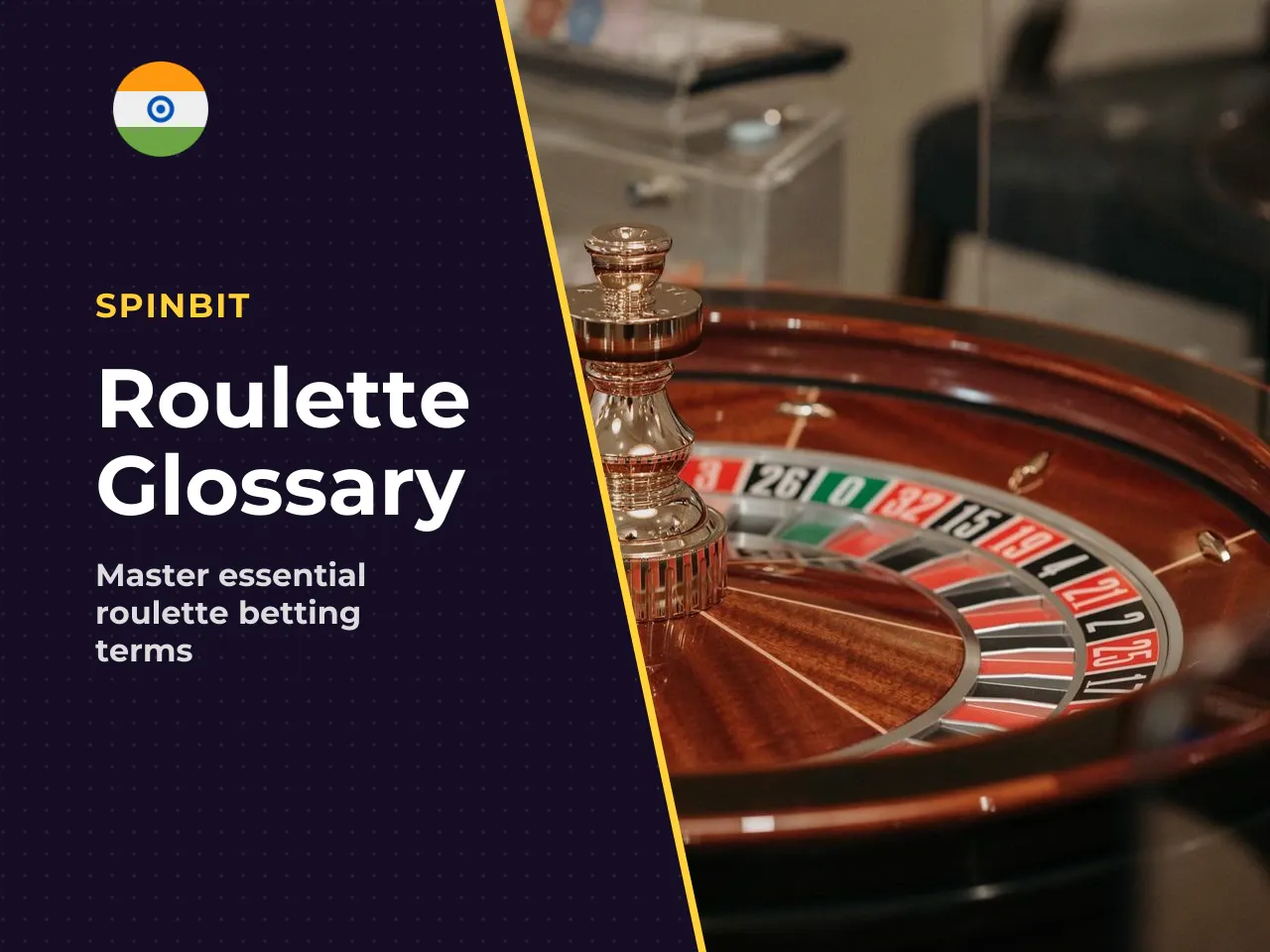
If you are still learning the vocabulary, these are the terms that appear most often in lobbies, pay tables and bonus terms.
Roulette is entertainment with a permanent negative expected value. That single sentence should shape every decision around it.
Set these controls before your first real-money spin:
Warning signs worth taking seriously: playing longer or bigger than planned, chasing losses right after a bad run, borrowing money to deposit, hiding play from family, losing sleep over results, or feeling relief only while the wheel spins. The research on between-session chasing is uncomfortable here: roulette shows the shortest return intervals after both wins and losses among the games studied, which means it invites a quick return more than most formats.
If gambling is affecting your finances, work, sleep or relationships, use the operator's deposit limits and self-exclusion tools and contact a local support service. Support is not a footnote; it is part of playing safely.
Content published by the Casino and Betting India editorial team. For platform-level reviews, licensing data and payout observations, see our iGaming coverage. Read first, decide slowly, and only then consider whether a roulette table is worth your money at all.